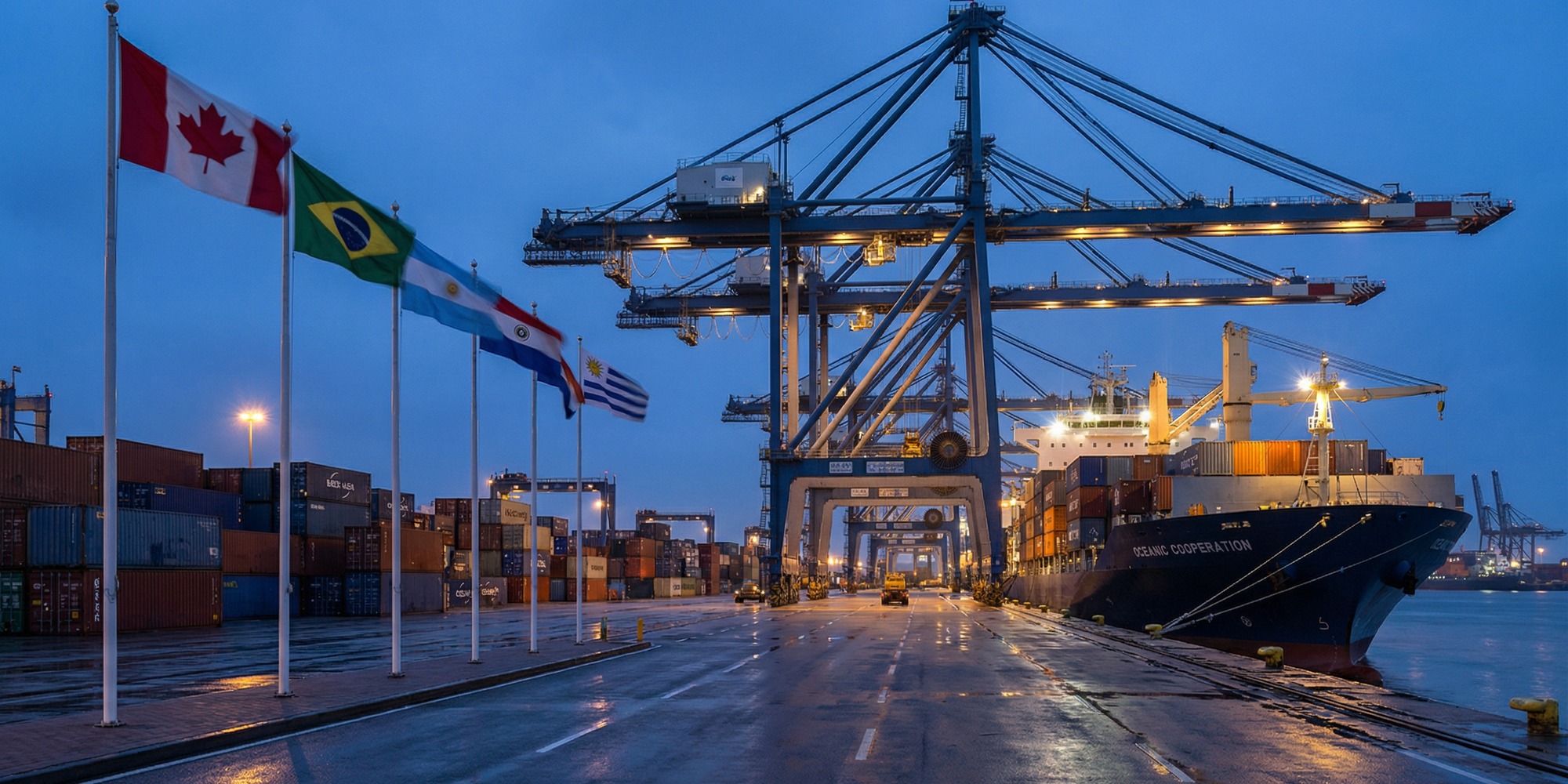
Canada and Mercosur have moved from exploratory diplomacy to timetable diplomacy. Reuters reported in late March that negotiators from Canada, Argentina and Brazil now expect a free-trade agreement to be concluded in 2026, with some officials pointing to a September-October signature window (Reuters, March 27; Reuters, March 27). The next negotiation round in Brasília is expected to test whether this accelerated pace is procedural ambition or an executable plan.
The stakes are straightforward but large. Global Affairs Canada says merchandise trade between Canada and Mercosur totaled CA$15.8 billion in 2024, including CA$3.1 billion in Canadian exports and CA$12.8 billion in imports (Government of Canada). For Ottawa, that is substantial enough to matter for diversification away from concentrated U.S. exposure; for Mercosur, it offers another developed-market anchor at a moment when the bloc is broadening its external agreements.
Key Takeaways
- Canadian and Mercosur officials told Reuters they are targeting a 2026 conclusion, with autumn seen as a plausible signature window.
- Canada reports CA$15.8 billion in 2024 goods trade with Mercosur, but with a sizeable import-heavy balance.
- Negotiations are being compressed into roughly six-week cycles, increasing pressure on legal drafting and sequencing.
- WTO data shows 380 RTAs in force as of January 2026, underscoring how standard trade diplomacy now competes on speed and ratification design.
From Relaunch to Compression
Canada and Mercosur originally launched FTA negotiations in March 2018, then entered a long period of slow progress before the process was relaunched (Government of Canada). What changed this year is the cadence. In Yaoundé, Canadian Trade Minister Maninder Sidhu said the parties aimed to negotiate about every six weeks, and "hopefully we can get it done by the fall" (Reuters).
"We're stepping up the negotiation timelines a little bit ... hopefully we can get it done by the fall."
— Maninder Sidhu, Canada's Minister of International Trade, speaking to Reuters on the sidelines of WTO meetings in Yaoundé (March 27, 2026)
Diplomatically, compressed calendars are often interpreted as political momentum. Legally, they can mean one of two things: either many chapters are already near closure, or parties are postponing hard trade-offs into a narrow final window. The Reuters reporting indicates frequent bilateral contacts with Argentina, Paraguay, Brazil and Uruguay, suggesting the file has moved beyond symbolic ministerial meetings and into chapter-by-chapter settlement pressure (Reuters).
Why This Deal Looks Different in 2026
The external environment is critical. Reuters and provincial officials in Ontario linked Canada's push partly to renewed tariff uncertainty in U.S. trade policy (Reuters). That diversification logic aligns with broader North American risk hedging already tracked in U.S. alliance and trade-policy reporting as Washington's strategic agenda shifts across theaters.
Mercosur, meanwhile, is negotiating from a stronger external profile than in prior cycles. The bloc signed agreements with the European Union in January 2026 after 25 years of talks, and the European Commission says key trade elements apply provisionally from May 1 for ratifying parties (Reuters, Jan. 17; Reuters, March 23; European Commission trade page). That sequence gives Mercosur practical experience with high-intensity legal drafting, implementation calendars, and domestic ratification choreography.
In other words, Canada is not negotiating with a bloc waiting for first-market access; it is negotiating with one that has just finalized another mega-file and can benchmark concessions in real time. This has direct implications for autos, agri-food, critical minerals processing, and procurement access — all areas where schedule design can matter as much as nominal tariff cuts.
WTO Rules, Notification, and the Ratification Bottleneck
Any final Canada-Mercosur deal will sit within WTO RTA disciplines. The WTO's regional-trade gateway notes that non-discrimination remains a core principle, while RTAs are permitted derogations under specific legal conditions, including those tied to GATT Article XXIV and services provisions under GATS Article V (WTO RTA gateway). The same WTO page says 380 RTAs were in force as of 13 January 2026, illustrating how crowded the institutional field has become.
That crowding changes the practical question. The issue is no longer whether a new FTA can be negotiated; it is whether it can be ratified and implemented with fewer legal ambiguities than peers. Experience from recent large accords suggests that interim application, chapter sequencing, and committee architecture can become political flashpoints. For Canada and Mercosur, the potential advantage of finishing quickly may be offset if domestic approval pathways perceive imbalance in agriculture, public procurement, or environmental safeguards.
Implications for Diplomacy and Markets
If an agreement lands by autumn, it would mark one of the fastest end-phases for a complex North-South negotiation in this cycle. It would also deepen a broader realignment where middle and major economies are building parallel trade corridors rather than waiting for comprehensive multilateral breakthroughs. For commodity-exposed investors, that matters because trade architecture influences shipping flows, capital expenditure plans, and currency risk premia — dynamics increasingly visible in global macro coverage and in U.S.-equity sector rotation tracked by US Market Updates.
The core diplomatic test, however, remains institutional rather than rhetorical: can both sides translate political urgency into a text that survives legal scrutiny and domestic politics? The answer should emerge not from headline targets, but from what negotiators can lock in on market access schedules, dispute procedures, and implementation timelines over the next two rounds.