Seven years after Nicolás Maduro ordered U.S. diplomatic staff out of Caracas, the United States and Venezuela announced on Thursday that they would restore full diplomatic and consular relations — a development that would have been almost inconceivable just months ago, before a U.S. military operation in January fundamentally altered South America's most resource-rich nation. The announcement came at the conclusion of a two-day visit to the Venezuelan capital by Interior Secretary Doug Burgum, who leads the Trump administration's National Energy Dominance Council.
Burgum's delegation, which included dozens of representatives from the oil, mining, and energy sectors, framed the diplomatic reset unmistakably: Venezuela's vast natural wealth sits at the core of Washington's recalibrated posture toward Caracas. The visit followed a February trip by Energy Secretary Chris Wright, who pressed Caracas for a "dramatic increase" in oil output and spoke of "tremendous opportunities" for both countries — a framing that has become the defining vocabulary of the new bilateral relationship.
Key Takeaways
- The U.S. and Venezuela agreed to restore diplomatic relations severed since 2019, just two months after a U.S. military operation toppled Nicolás Maduro in January 2026.
- Interior Secretary Doug Burgum visited Caracas on March 4–5, leading a delegation of energy and mining company representatives and securing investment assurances from acting President Delcy Rodríguez.
- Venezuela holds the world's largest proven oil reserves and significant deposits of gold, coltan, and rare minerals critical to electronics manufacturing.
- The State Department said engagement is "focused on helping the Venezuelan people move forward through a phased process" toward a democratically elected government.
- Nobel Peace Prize laureate María Corina Machado has announced plans to return to Venezuela, with elections expected to follow the transition period.
From Adversaries to Partners — A Condensed History
Relations between Washington and Caracas deteriorated progressively over two decades of ideological antagonism under the Chávez and Maduro governments, collapsing entirely in January 2019. The first Trump administration publicly endorsed opposition lawmaker Juan Guaidó as Venezuela's legitimate interim president; Maduro responded by expelling American diplomats and ordering the U.S. embassy shuttered. Washington moved its Venezuela mission to neighboring Colombia, and the two countries entered a period of sustained confrontation characterised by escalating U.S. sanctions targeting Venezuela's oil exports, financial system, and government officials.
The rupture proved durable. Multiple mediation efforts — in Mexico City, Barbados, and through Caribbean intermediaries — failed to produce durable outcomes. By 2024, International Monetary Fund estimates placed Venezuela's economic contraction at more than 75 percent from its 2014 peak, with over 7.7 million Venezuelans having fled the country in one of the Western Hemisphere's most acute displacement crises.
The seismic rupture came on January 3, 2026, when U.S. forces conducted an operation targeting Caracas that left approximately 100 people dead and resulted in the capture of Maduro and his wife, who were subsequently flown to New York to face long-standing federal drug trafficking charges. The operation — executed without a prior UN Security Council mandate — sent shockwaves through Latin America, with regional governments sharply divided over its legality and long-term implications for hemispheric sovereignty norms.
Resource Diplomacy at the Core
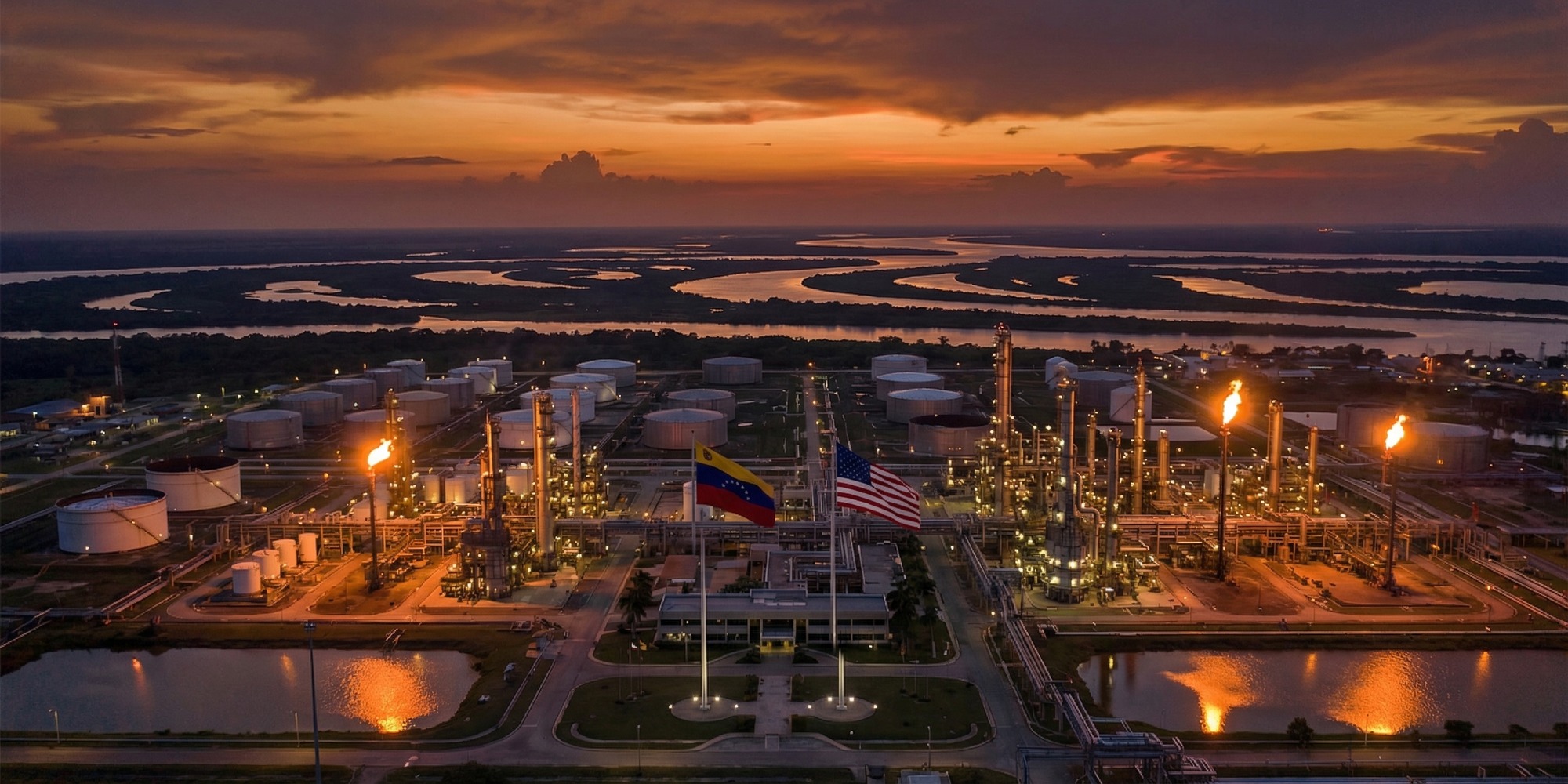
Venezuela's importance to the Trump administration's energy strategy cannot be overstated. The country holds the world's largest proven petroleum reserves — some 303 billion barrels according to OPEC data — and is also rich in gold, diamonds, bauxite, and coltan, the metallic ore essential to mobile phones and electronic components that Western governments have identified as strategically critical. The Orinoco Mining Arc, a resource belt spanning approximately 111,843 square kilometres of southeastern Venezuela, has drawn intense commercial interest, though armed groups remain active across significant portions of the region.
"The re-establishment of diplomatic and consular relations will facilitate our joint efforts to promote stability, support economic recovery, and advance political reconciliation in Venezuela."
— U.S. State Department statement, March 5, 2026
Shell has signed new on- and offshore oil and gas agreements following Burgum's visit, and Burgum told reporters that dozens of additional companies had expressed interest in investing. "I think you're going to see this government very concerned about providing the right kind of security," he said, describing his meetings with acting President Rodríguez as "fantastically positive" and predicting Venezuela would surpass its oil and gas production targets this year. As global oil markets remain under pressure — driven in part by Iran's disruption of Strait of Hormuz shipping lanes — Venezuela's expanded output could provide meaningful relief to tight crude supplies.
Rodríguez overhauled Venezuela's state-controlled oil sector last month to enable a wave of private investment and is now working to update the country's mining code, signalling an accelerated push to attract foreign capital to the Orinoco Arc. Trump praised her publicly on Truth Social, writing that "Delcy Rodríguez, who is the President of Venezuela, is doing a great job, and working with US Representatives very well."
Democratic Legitimacy and the Path to Elections
The diplomatic reset has generated significant controversy within Venezuela and across the region. Trump's decision to work with Rodríguez — formerly Maduro's vice president — rather than with the mainstream democratic opposition has unsettled advocates who spent years campaigning for Maduro's removal, only to find the post-Maduro transition managed by one of his most trusted lieutenants. The contrast with U.S. hemispheric policy precedents is stark: Washington has historically conditioned normalization of relations on credible democratic benchmarks, not resource access agreements.
Venezuela approved an amnesty law in recent weeks that has enabled the release of hundreds of politicians, activists, lawyers, and others imprisoned for political motivations — an implicit acknowledgment that the Maduro-era government held people unjustly. The opposition's principal figure, María Corina Machado, who was awarded the 2025 Nobel Peace Prize, met with Trump in January and presented him with her Nobel medal. On Sunday she announced she would return to Venezuela in the coming weeks and that elections would be held — a development that, months earlier, few analysts would have considered plausible.
Venezuela's foreign ministry framed the diplomatic restoration in carefully diplomatic language, saying it would "move forward in a new stage of constructive dialogue, based on mutual respect, the sovereign equality of states and cooperation between our people." Rodríguez added on state television that reestablishing relations "will strengthen relations between our two countries" and "ought to result in the social and economic happiness of the Venezuelan people." The wider pattern of Trump-era diplomatic engagement suggests Washington's approach varies markedly by context — confrontational toward Iran, transactional toward Caracas — calibrated primarily to strategic and commercial interests rather than ideological consistency.
Implications for Hemispheric Order
The U.S.-Venezuela agreement represents a marked departure from traditional hemispheric policy norms — not because Washington is restoring ties with a former adversary, but because of the conditions under which those ties collapsed and are now being rebuilt. The Trump administration's willingness to work with a senior Maduro loyalist, while bypassing the recognized opposition and conditioning normalization on resource access, reflects a transactional logic that has defined the administration's broader foreign policy posture.
For Latin American governments, the episode sets precedents of consequence. Caracas has, in effect, exchanged sovereign control of its natural resource sectors for political survival and international legitimacy. Regional powers including Brazil, Colombia, and Mexico — all of whom condemned the January military operation — are now navigating a normalized U.S.-Venezuela relationship that they had no role in shaping. The long-term stability of the Rodríguez government, the credibility of the promised electoral transition, and the pace of private investment into the Orinoco Arc will be the primary indicators of whether the reset delivers what both Washington and Caracas have publicly committed to: a stable, prosperous, and ultimately democratic Venezuela.