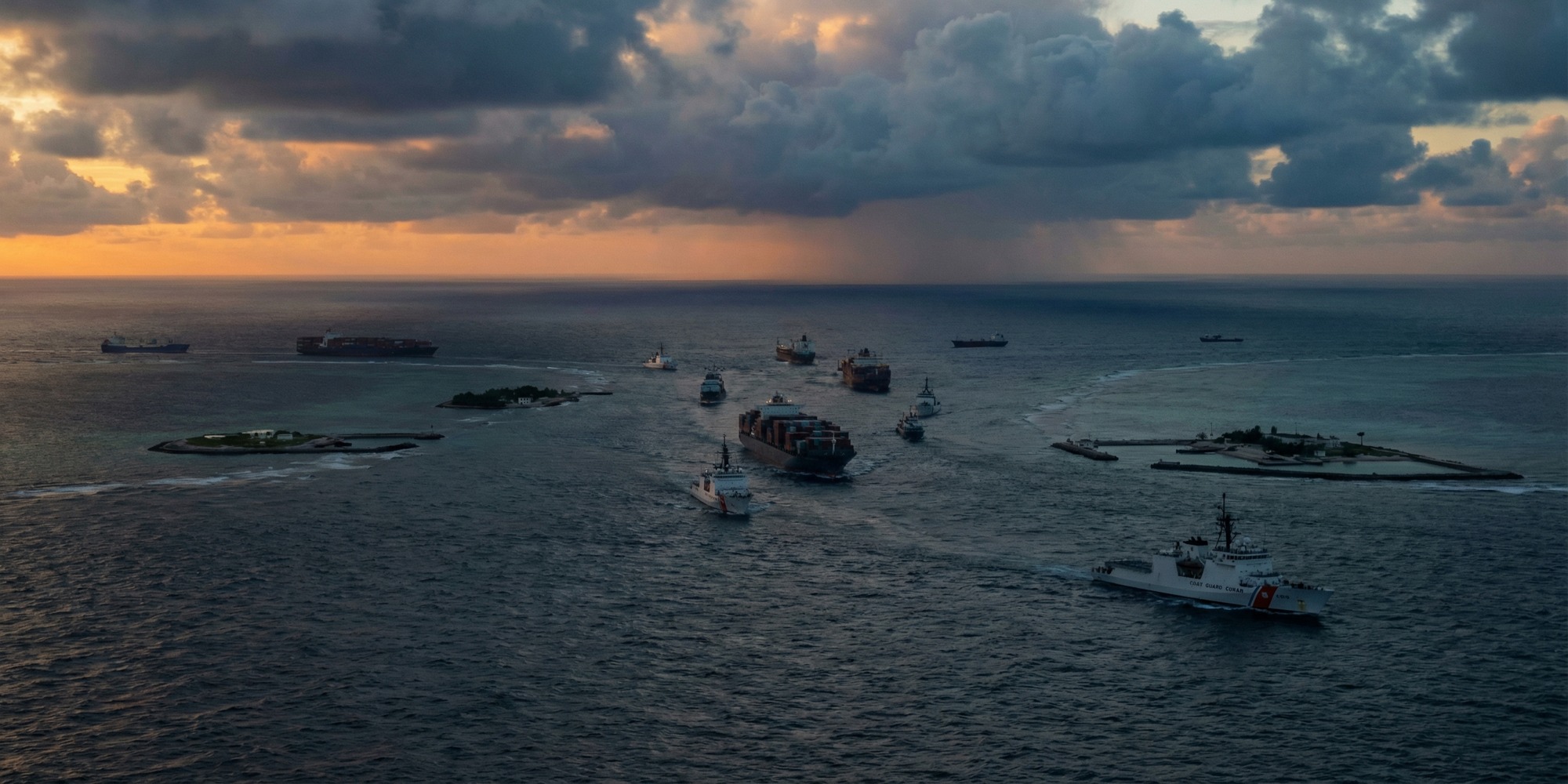
At Ayungin Shoal, known internationally as Second Thomas Shoal, tactical de-escalation has not produced strategic settlement. A July 2024 “provisional agreement” allowed a Philippine resupply mission to proceed without collision, according to Reuters, after months of dangerous encounters between Chinese and Philippine vessels (Reuters, July 27, 2024). Yet the same report underscored that both governments said the arrangement did not alter their legal positions.
The immediate gain was operational. The unresolved dispute was legal and geopolitical. That distinction now defines the conflict’s current phase, in which coast guard behavior, alliance signaling, and law-of-the-sea doctrine all matter at once.
Key Takeaways
- Reuters reported repeated water-cannon and ramming incidents around Ayungin before Manila and Beijing implemented a provisional resupply arrangement.
- The 2016 arbitral award held that China’s expansive South China Sea claims had no legal basis under UNCLOS.
- UNCLOS Part III states that transit passage through international straits “shall not be impeded,” framing broader maritime legal expectations.
- De-escalation at one shoal has reduced near-term risk, but competing sovereignty narratives still drive recurring confrontation.
What Changed After the Mid-2024 Escalation
In March 2024, Reuters documented one of the sharpest episodes in the cycle: China’s coast guard used water cannons and Philippine officials reported injuries and vessel damage during a resupply operation (Reuters, March 23, 2024). Beijing said it had acted lawfully; Manila called the actions “irresponsible and provocative.”
“In straits referred to in article 37, all ships and aircraft enjoy the right of transit passage, which shall not be impeded.”
— United Nations Convention on the Law of the Sea, Part III, Article 38(1)
Although Ayungin itself is not governed by straits language in the same way as a chokepoint like Hormuz, UNCLOS text remains central to regional legal framing. The same convention’s provisions on exclusive economic zones and maritime rights continue to anchor both legal argument and diplomatic messaging (UNCLOS Part III).
Legal Position Versus Enforcement Reality
The legal benchmark remains the 2016 South China Sea arbitral award. The tribunal found that China’s broad “historic rights” claims in the disputed sea lacked legal basis under the convention framework, a finding repeatedly cited by Manila and by external partners (Permanent Court of Arbitration award, July 12, 2016; Reuters summary).
But legal rulings do not self-enforce. The resupply arrangement worked because both sides saw value in capping incident risk, not because either side accepted the other’s sovereign claim. That gap between legal position and operational behavior is exactly why regional militaries still plan for contingency signaling, including U.S.-allied maritime coordination examined in recent U.S. alliance analysis.
The economic layer is equally clear. Even localized confrontations in major shipping corridors can alter energy and freight expectations, with spillovers into broader risk pricing already reflected in global macro coverage and in U.S. equity sensitivity to geopolitical shocks tracked by US Market Updates.
From Incident Diplomacy to Managed Friction
The July 2024 arrangement mattered because it shifted the immediate operating pattern. Reuters reported that earlier encounters had included high-pressure water-cannon use, near-contact maneuvering, and accusations of ramming by both sides (Reuters, March 23, 2024; Reuters, July 27, 2024). The provisional formula did not normalize relations, but it created a working method that reduced the probability of immediate injury events during routine resupply runs.
That outcome is consistent with other maritime disputes where parties compartmentalize practical risk management from sovereignty bargaining. In effect, both capitals can claim continuity in principle while accepting temporary procedure in practice. This is one reason the arrangement has proven politically survivable despite domestic criticism in both countries: it avoids legal concession language while still lowering tactical danger at sea.
For diplomats in Southeast Asia, the deeper implication is that procedural confidence-building can buy time, but only if it is repeatedly renewed and insulated from wider geopolitical shocks. A new incident elsewhere in the South China Sea, or a sharp military signaling cycle among external powers, could quickly collapse this narrow stability channel.
Implications for the Next Diplomatic Cycle
The most likely near-term trajectory is managed friction. Manila will continue asserting rights inside what it describes as its 200-nautical-mile EEZ, while Beijing will continue patrol and interdiction practices tied to its own maritime claims. Periodic tactical understandings may reduce direct collision risk, but they do not remove the structural dispute.
For regional diplomacy, this makes process design as important as legal doctrine. Crisis hotlines, notification practices, and mission protocols can prevent incidents from escalating into alliance crises. Without those mechanisms, even a single resupply encounter can trigger wider military signaling.
The Ayungin case therefore offers a narrower but useful lesson for conflict management: legal language sets the frame, but predictable operational rules determine whether ships, governments, and markets can function through persistent dispute. The South China Sea contest remains unresolved, yet it is increasingly governed by how well both sides separate day-to-day maritime safety from long-term sovereignty competition.
That pattern — a tactical arrangement that lowers collision risk without settling the legal claim — is the same South China Sea operating logic documented on the Armed Conflicts Map's South China Sea disputes page.