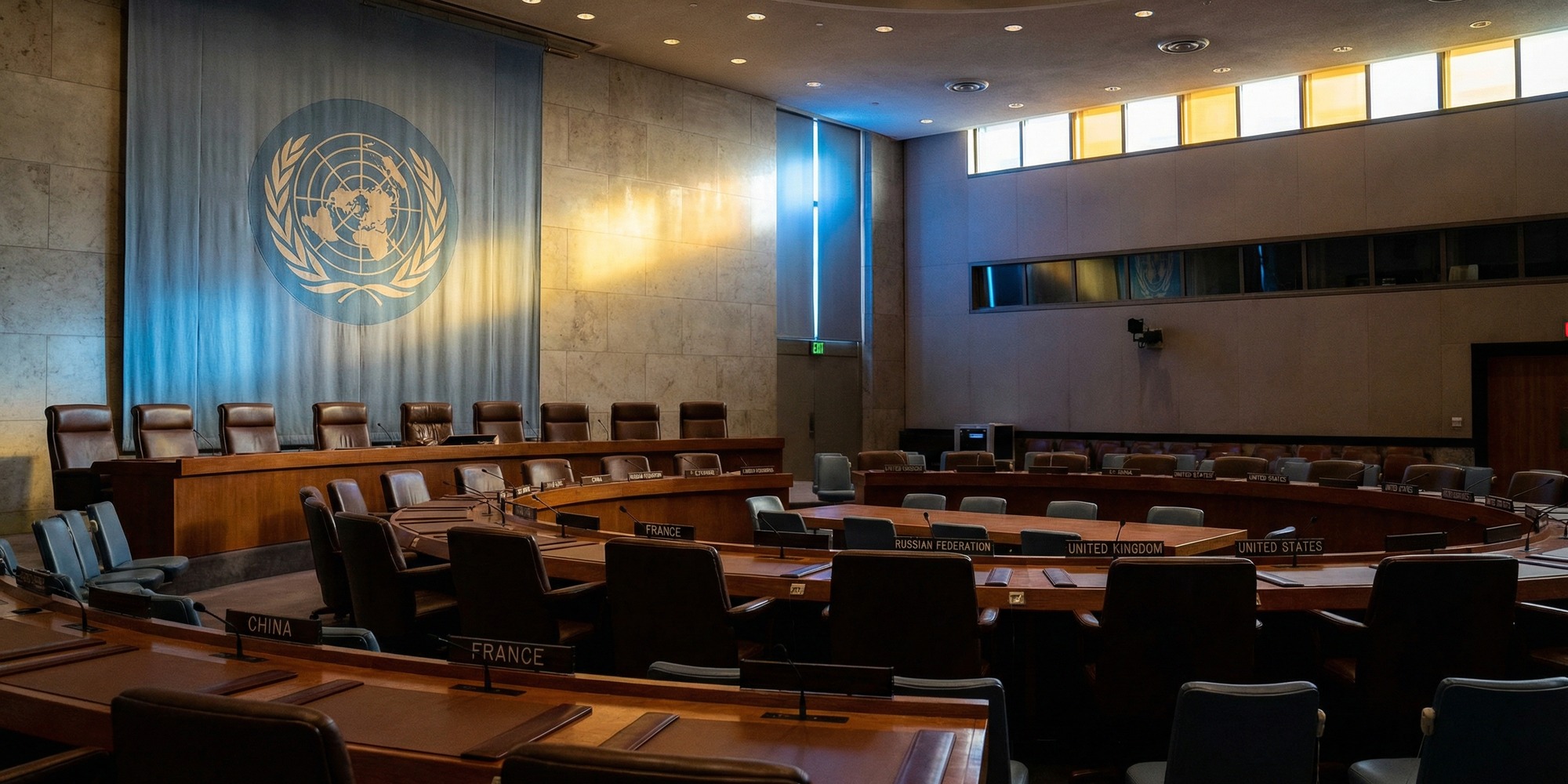
Shortly before 11:00 AM on Good Friday — the time at which the UN Security Council was scheduled to vote on Bahrain's resolution authorizing protective force in the Strait of Hormuz — the vote quietly disappeared from the schedule. The official explanation was that the United Nations observes Good Friday as a public holiday, a fact that was known when the vote was announced. No new date was offered. The world's most consequential waterway remains closed, and the council that is supposed to maintain international peace and security has, for now, produced nothing beyond a delay.
The postponement is both procedurally mundane and diplomatically revealing. The Security Council had been working for weeks to produce a text that could pass. Through six separate drafts, Bahrain and its co-sponsors — including the United States — progressively stripped away the resolution's teeth: first removing broad geographic scope, then, most significantly, eliminating any reference to Chapter VII of the UN Charter, the provision that gives the Security Council authority to authorize armed force. What remained was authorization for "all defensive means necessary and commensurate with the circumstances" — a legal distinction that still has not convinced Russia or China to commit their votes.
Key Takeaways
- The UNSC's Good Friday vote on securing Hormuz navigation was postponed with no rescheduling — the official reason was a UN holiday, but deeper P5 divisions remain unresolved.
- Bahrain's resolution was revised through six drafts, ultimately removing Chapter VII force authorization language entirely to try to court Russia, China, and France.
- Russia and China are expected to veto even the watered-down defensive-only text, with both insisting that political settlement of the war — not maritime security measures — is the prerequisite.
- The Strait of Hormuz carried roughly 20% of globally traded oil before Iran's closure; Brent crude has exceeded $115 per barrel, and fuel surcharges are spreading to aviation markets worldwide.
Six Drafts and a Compromise
Bahrain's original resolution was written with intent. It invoked Chapter VII explicitly and authorized member states "to use all necessary means" — the standard Security Council phrase for military force — across the Strait of Hormuz, the Gulf, and the Gulf of Oman to secure navigation. In the council's history, that language has appeared in some of its most consequential votes: Resolution 678 in 1990, which authorized the Gulf War coalition against Iraq, and Resolution 1973 in 2011, which cleared the way for NATO's intervention in Libya.
But Chapter VII authorization requires, at minimum, no veto from any of the five permanent members. And three of the five — Russia, China, and France — signaled discomfort with the original text. France's objections centered on the breadth of force authorized; President Emmanuel Macron had earlier declared that a military operation to free the waterway was "unrealistic." Russia, a long-standing partner of Tehran, opposed what it characterized as one-sided measures that treated the Hormuz crisis as a security problem rather than a consequence of an ongoing war. China, which depends on Gulf energy supplies but has not aligned with Western positions on the conflict, warned that authorizing force "would amount to legitimizing the unlawful and indiscriminate use of force" and would risk further escalation.
"Authorizing member states to use force would amount to legitimizing the unlawful and indiscriminate use of force, which would inevitably lead to further escalation of the situation and lead to serious consequences."
— Fu Cong, China's UN Ambassador, addressing the Security Council, April 2, 2026
By the sixth draft, the resolution had been reduced to defensive authorization only — with no Chapter VII citation, no offensive action permitted, and a requirement that countries or "voluntary multinational naval partnerships" provide advance notification to the Security Council before acting. The measure would apply in "the Strait of Hormuz and adjacent waters" and remain in force for "at least six months." France's ambassador Jérôme Bonnafont indicated this version "might be acceptable," calling for "defensive measures that avoid any broad use of force." Whether Russia and China share that view remains unknown.
The Veto Calculus
Analysts familiar with Security Council dynamics are not optimistic. Daniel Forti of the International Crisis Group told AFP that the text "faces tall odds to make it through the Security Council," noting that it is "hard to see" Russia and China "supporting a resolution that treats stability in the strait exclusively as a security issue, instead of one that also grapples with the need for a durable political end to the hostilities."
Russia's UN Ambassador Vassily Nebenzia put it more bluntly: the proposal "does not solve the puzzle." What would solve it, in Moscow's telling, is ending the war itself. That position is not without logic — the Hormuz closure is a direct consequence of the US-Israel military campaign against Iran that began February 28, and Russia has consistently framed its opposition to Western-sponsored measures as opposition to one-sided interventionism rather than support for Iran's tactics.
Bahrain's Ambassador Jamal Alrowaiei, who has shepherded the resolution through six revisions, offered a counterpoint that reflected the position of the Gulf states directly bearing the costs of Iran's maritime pressure:
"We cannot accept economic terrorism affecting our region and the world — the whole world is being affected by the developments."
— Jamal Alrowaiei, Bahrain's UN Ambassador, April 2, 2026
The prior Security Council action on Hormuz — a March 11 resolution that condemned Iran's "egregious attacks" on Gulf nations and called for an immediate halt to the blockade — passed 13-0 with Russia and China abstaining rather than vetoing. That was a condemnation with no enforcement mechanism. The current resolution is the enforcement step, which is precisely why P5 dynamics have hardened. Condemning a situation costs little; authorizing protective action, even defensive action, creates obligations and precedents that permanent members weigh more carefully.
The United States' own veto strategy at the Security Council has itself drawn scrutiny throughout the Iran war, with Washington insisting it retains latitude to shield its military operations from council oversight while simultaneously seeking council authorization for protective measures that serve US interests.
What Defensive Means — And What It Does Not
The practical question of what the resolution would actually authorize matters beyond its diplomatic symbolism. "Defensive means" in this context would likely permit naval escorts for commercial vessels transiting the strait, anti-drone and anti-missile defense systems deployed at sea, and electronic countermeasures — but not offensive strikes against Iranian shore installations, naval vessels conducting blockade operations, or the kind of clearing operations that would be required to force the strait open against active Iranian resistance.
That limitation matters because Iran's closure of the strait is not passive. Iranian naval forces have engaged in selective interdiction — boarding vessels, imposing informal tolls, and threatening tankers — rather than simply mining the waterway. A purely defensive mandate provides little authority to intercept or deter that kind of active interference. The gap between what the resolution would authorize and what restoring free navigation would actually require is one reason analysts are skeptical of its operational significance even if it passes.
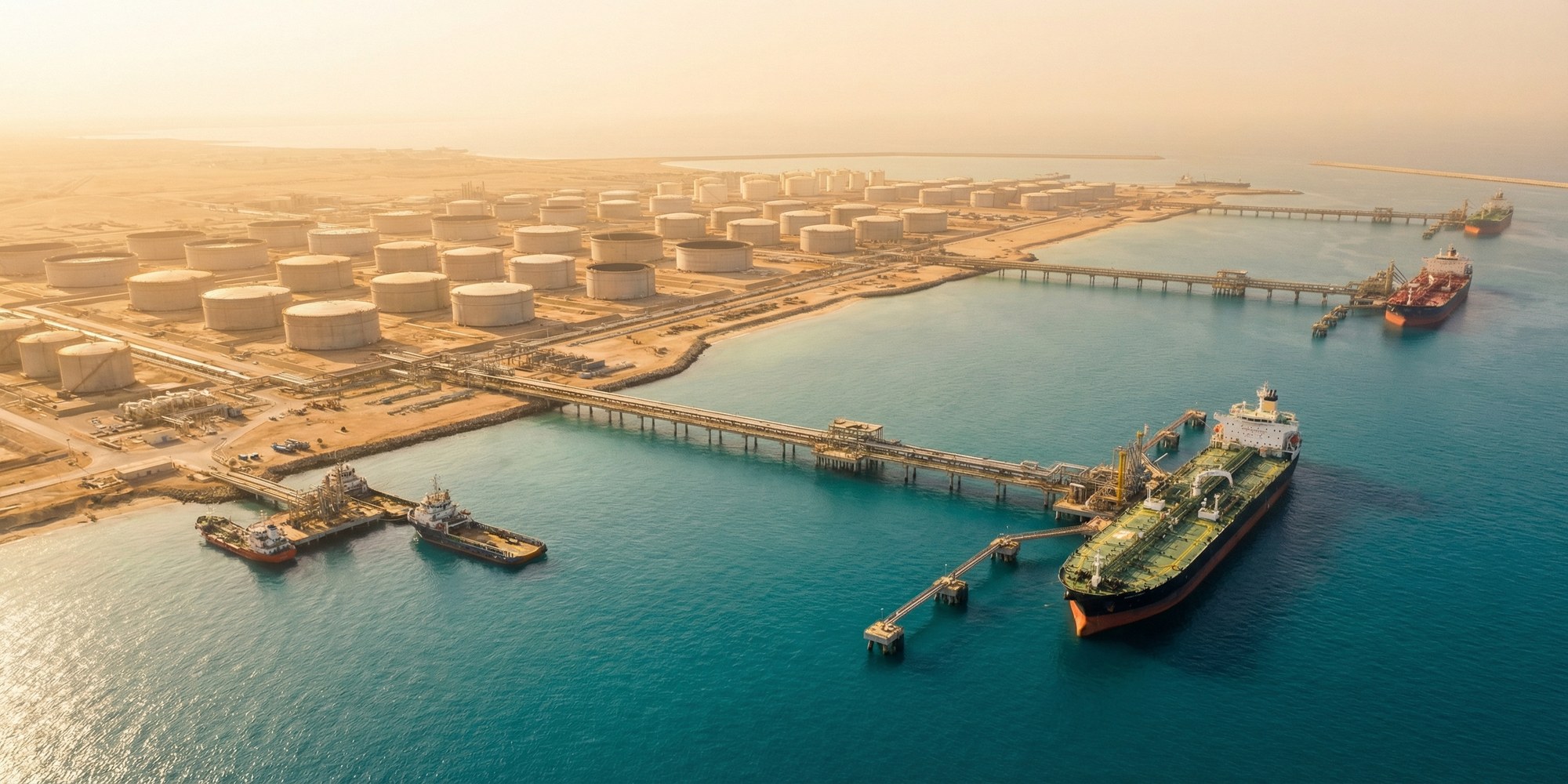
The economic consequences of that gap are accumulating daily. Before the war began, roughly 20% of globally traded oil passed through the Strait of Hormuz, along with significant volumes of liquefied natural gas and petrochemical feedstocks critical to global fertilizer production. Brent crude has exceeded $115 per barrel, as tracked by Global Market Updates. Chinese airlines including China Eastern have announced fuel surcharge increases effective April 5. Food security analysts are flagging fertilizer supply disruptions that could affect harvests in the developing world later this year. The effects on US financial markets have been volatile as investors weigh energy inflation against any signs of diplomatic progress.
A Council and Its Limits
The Hormuz resolution process is a case study in what happens when the Security Council's architecture of great-power consensus meets a conflict in which those great powers are actively aligned on opposing sides. The system was designed by its founders in 1945 with the explicit assumption that the permanent five would agree on fundamental security questions; the veto exists precisely to prevent the council from being used against the interests of its most powerful members. When two P5 members have strategic ties to one of the parties in an active conflict, the council's ability to authorize meaningful action against that party's conduct collapses.
This is not the first time the Security Council has reached this limit. The Syria conflict produced years of vetoed resolutions between 2011 and 2019, as Russia and China blocked Western-sponsored measures on chemical weapons use and civilian protection. The pattern there — condemnation without enforcement — appears to be repeating in the Gulf. The March 11 Hormuz condemnation passed without Russian or Chinese opposition because it carried no binding obligations. The April 3 enforcement step has stalled for the same reason its Syrian predecessors did: authorization for action is a different category of commitment than expression of concern.
Britain has been holding coordination calls with approximately 35 nations on how to reopen the strait once the fighting ends — suggesting that Western planning has already shifted toward post-conflict mechanisms rather than a Security Council-mandated interim solution. That pragmatic workaround may ultimately be more consequential than any vote the council takes or fails to take. But it also marks a further erosion of the institution's claimed authority over international security, an erosion that will outlast the immediate crisis in the Gulf.
What Comes Next
The Security Council has not set a new vote date as of Friday morning. Diplomatic sources indicate that consultations will continue through the Easter weekend, with a possible vote early next week — though the fundamental P5 division that produced the delay has not been resolved by the postponement. Russia and China's positions do not appear to have shifted; France has signaled cautious support for the defensive-only text but has not publicly committed its vote.
If the resolution fails — either through explicit veto or through continued procedural delay — the practical consequence will likely be the formation of informal multilateral naval coalitions operating without a Security Council mandate, similar in structure to the combined maritime forces that operated against Houthi attacks in the Red Sea in 2023 and 2024. The legal basis for such operations would rest on individual nations' rights of self-defense and transit passage under the United Nations Convention on the Law of the Sea, rather than an authorizing resolution.
The longer the council remains unable to act, the clearer the lesson it teaches: that in conflicts touching the core strategic interests of permanent members, the institution's authority is more declaratory than operational. That lesson will be studied in foreign ministries well beyond the current crisis, by governments calculating what the Security Council can and cannot be relied upon to do.
A Hormuz protective-force draft stripped of Chapter VII language, then pulled from the Friday calendar, is the same Council failure recorded on the Armed Conflicts Map's Strait of Hormuz crisis page.