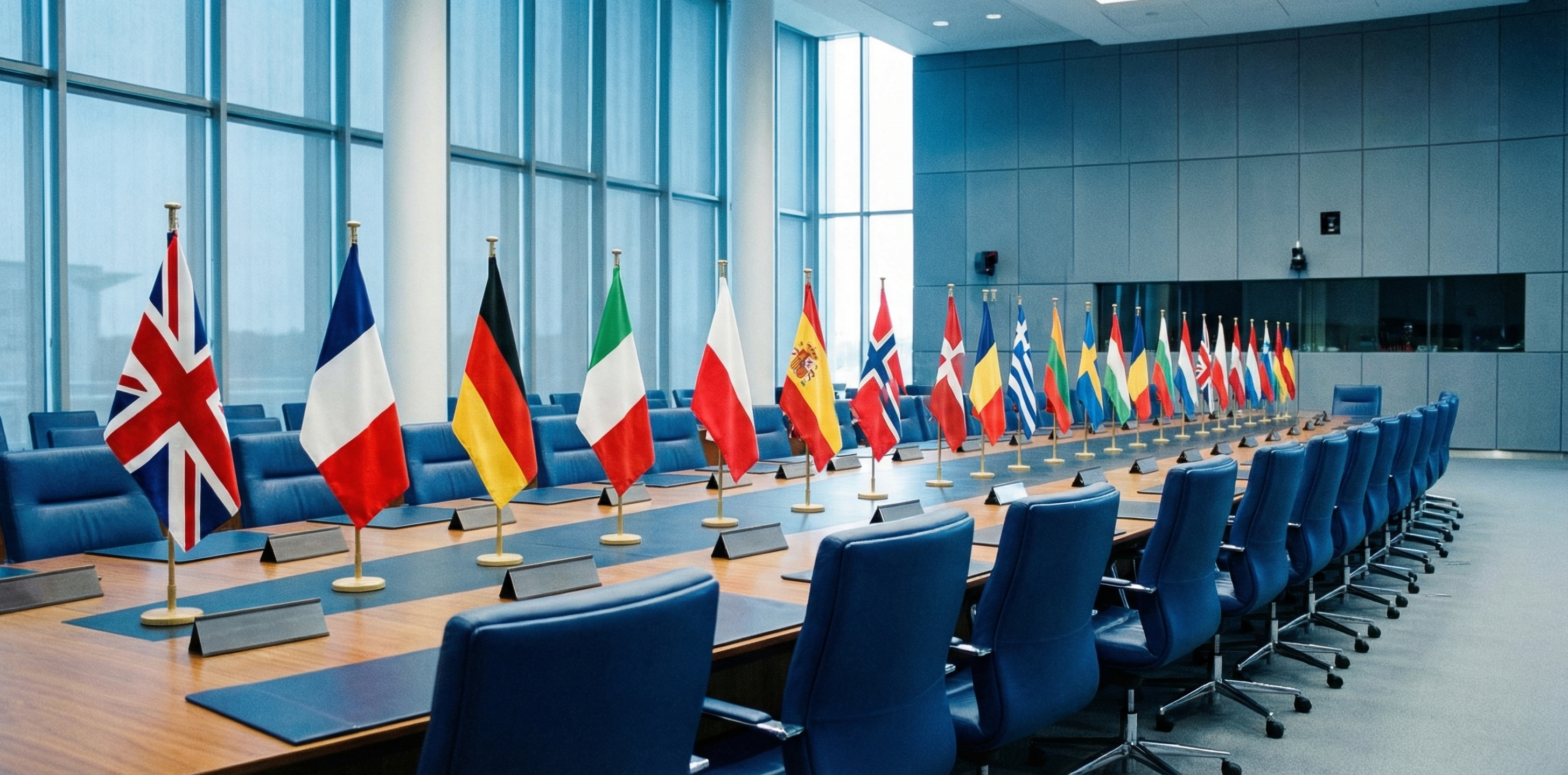
NATO is showing its sharpest internal split in years, as European members distance themselves from the US-Israeli military campaign against Iran while trying not to jeopardize the American military guarantees, Ukraine war diplomacy, and trade relationships that make an open break with Washington unaffordable. The result: European governments condemning neither the strikes nor Washington outright, a middle position that has left Washington irritated and European capitals exposed.
European allies were emphatic from the outset that they had not participated in the February 28 strikes and bore no responsibility for the military campaign, according to reporting by The Washington Post. The declaration — made by France, Germany, the United Kingdom, and other member states within hours of the strikes commencing — reflected both a factual reality (no European forces participated) and a deliberate political signal: these governments did not endorse the action and sought to preserve their standing as potential mediators.
Trump Criticises European Hesitancy
President Trump's response was pointed. In remarks reported by Politico on March 3, Trump criticised European allies for their failure to offer public support for the operation, framing their non-participation statements as unhelpful at a moment when the United States was bearing the primary military burden of degrading what he described as a shared security threat. The criticism reinforced a pattern in which European governments find themselves navigating not only the immediate crisis but the broader strategic challenge of an American administration that regards expressions of European independence as strategic defection rather than legitimate allied diplomacy.
The irony of the moment was not lost on analysts tracking intra-alliance dynamics. Germany's Chancellor Friedrich Merz — in office since February 2025 and committed to strengthening European defence capacity — was simultaneously pressing Spain to increase its NATO defence spending to the 2% GDP threshold, according to Politico. The push reflects a post-Ukraine European consensus on defence investment, but it sits awkwardly alongside the Iran crisis, in which Spain's refusal to allow US forces to use jointly operated bases triggered Trump's threat of a full trade embargo under IEEPA — a measure that would tear a significant economic hole in the bilateral relationship.
"The United States and Israeli actions represent a squandering of an opportunity for diplomacy that was available until the very last moment before the strikes commenced."
— UN Secretary-General António Guterres, as cited in the House of Commons Library research briefing on the Iran conflict, March 2026. Guterres condemned both the US-Israeli strikes and Iran's counter-strikes as violations of international law.
The Incirlik Incident and NATO's Article 5 Question
The most acute test of alliance cohesion came on March 3, when Iran launched a ballistic missile at Incirlik Air Base in Turkey — a NATO installation hosting both Turkish and American military assets. The missile was intercepted and destroyed by NATO air defence systems before impact, according to The New York Times. The incident raised immediate questions about Article 5 obligations: an attack on a NATO member's territory is, in principle, an attack on all members.
Turkey's response was notably restrained. Ankara, which maintains complex relationships with both Washington and Tehran, declined to invoke Article 5 or to publicly frame the missile attack as a casus belli requiring collective alliance response. The calculation — which reflects Turkey's broader strategic positioning as a NATO member that has simultaneously maintained trade and diplomatic ties with Russia and pursued constructive relationships with Iran — effectively prevented an escalatory spiral that a formal Article 5 invocation might have triggered. European capitals privately welcomed Ankara's restraint while noting the precedent it sets for how alliance obligations are interpreted under political pressure.
Europe's Delicate Balance: Ukraine, Iran, and Leverage
European governments face a structural dilemma that has no clean resolution. The Ukraine conflict remains their most immediate security priority, and the US remains the indispensable supplier of weapons, intelligence, and political support for Kyiv. Any overt break with Washington over Iran risks Washington's willingness to sustain that support — a leverage relationship that the Trump administration has not been shy about invoking. European leaders are therefore compelled to express their concerns through private diplomatic channels and carefully worded public statements rather than direct confrontation.
The UK and France, as permanent UN Security Council members, requested the emergency UNSC sessions that have so far failed to produce any binding resolution — a form of institutional opposition that stops well short of bilateral confrontation with Washington. Germany and the Nordic states have called for diplomatic negotiations without endorsing the strikes. The Gulf Cooperation Council states — themselves targeted by Iranian retaliatory attacks and critically dependent on US security guarantees — have maintained an even more constrained public posture, balancing their opposition to Iranian aggression with deep unease about the scale of the US-Israeli campaign.
The energy market consequences of the conflict are already reverberating globally. As tracked in analysis of the energy market fallout, Brent crude hit a 14-month high of $81.40 on March 3, with analysts warning that a sustained Strait of Hormuz disruption could push prices toward $100/barrel — a scenario with severe implications for European economies already managing elevated energy costs in the post-Ukraine environment. For European publics facing energy price pressures, the optics of an American-led military operation generating an oil shock add a further layer of political difficulty for governments seeking to manage allied solidarity without domestic backlash.
The Diplomatic Horizon
European capitals are watching the horizon for any opening in which they can play a constructive mediating role without appearing to undermine the US campaign. Oman, which hosted several rounds of indirect US-Iranian nuclear negotiations prior to the strikes, has signalled a willingness to continue facilitating back-channel communications. Qatar has indicated similar availability. The British government has reportedly maintained discreet contacts with Iranian interlocutors, though the scope and ambition of those discussions remain closely held.
What is clear is that the diplomatic framework Europe had relied upon — multilateral negotiations under the JCPOA architecture, UN Security Council mechanisms, and transatlantic consultation before major military action — has been comprehensively dismantled. Understanding how that architecture failed, and what the military operation's stated objectives actually are, requires examining Operation Epic Fury in its full policy context. The path back to a functioning transatlantic consensus on Iran — if one exists — runs through an escalation dynamic that European governments can influence at the margins but cannot control.
Trump has stated he does not rule out ground forces and described a timeline of "one month or less" for the campaign's primary objectives. European governments, for their part, are managing the gap between their private assessments of what that timeline implies and the public positions they can credibly maintain without precipitating a transatlantic crisis that would benefit neither side.
The alliance split over whether to back the Iran campaign is one front of the same 2026 Iran–US war documented on the Armed Conflicts Map's Iran–US war tracker.