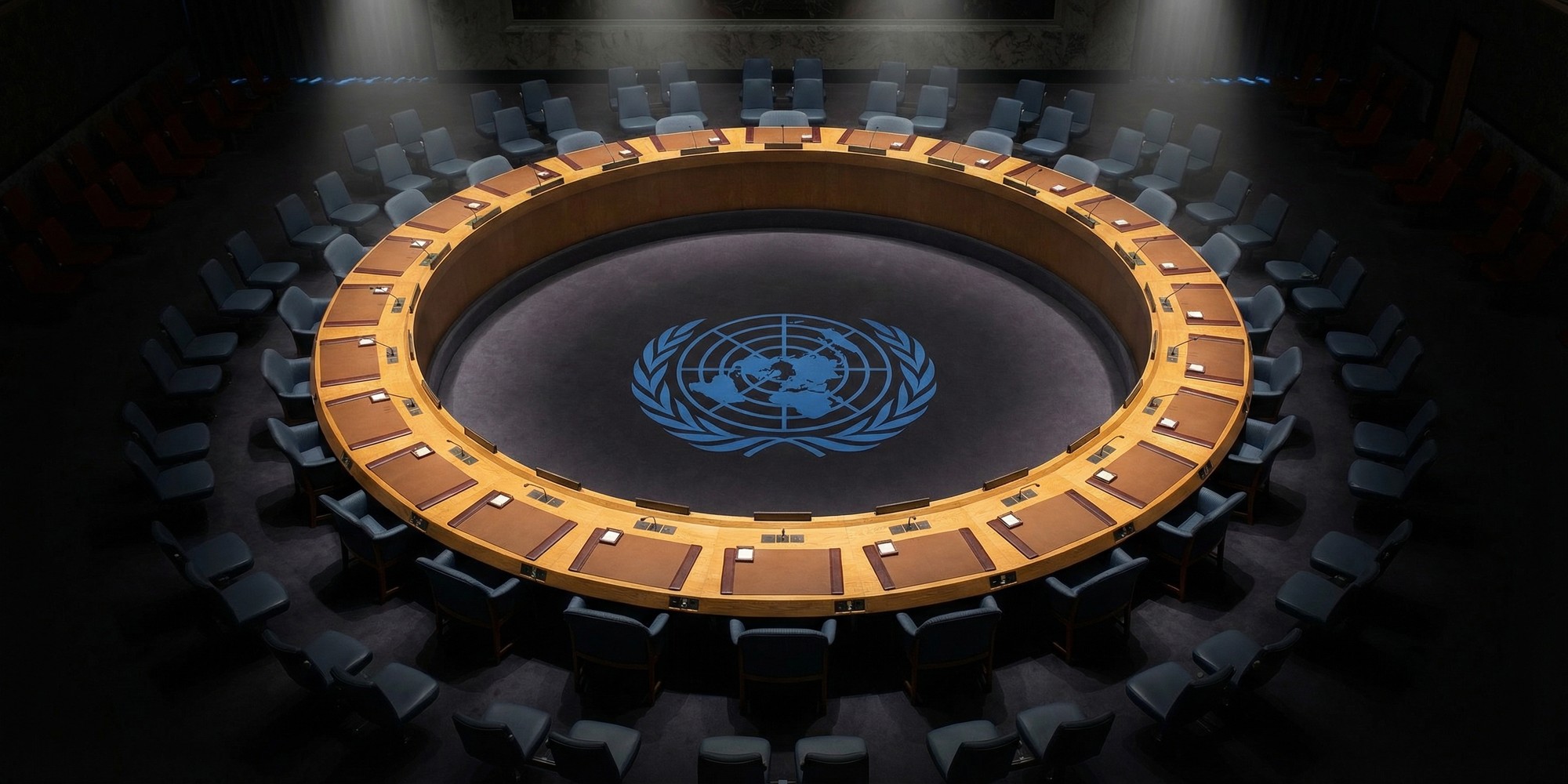
Five days after coordinated United States and Israeli military strikes transformed the Middle East security landscape, the United Nations Security Council remains unable to forge a unified diplomatic response. Two emergency sessions have yielded impassioned speeches from all sides but no resolution — a reflection of the structural paralysis that has long defined the council's handling of conflicts in which a permanent member holds a direct stake.
Sources: Associated Press · UN News · Better World Campaign
The Emergency Sessions: Clash Without Consensus
The first emergency session convened within hours of the initial strikes on February 28, 2026, following a request from France, Russia, China, Bahrain, and Colombia. UN Secretary-General António Guterres set a confrontational tone from the outset, stating that the US and Israeli airstrikes violated international law, including the UN Charter, while simultaneously condemning Iran's retaliatory strikes against Bahrain, Iraq, Jordan, Kuwait, Qatar, Saudi Arabia, and the United Arab Emirates.
"We are witnessing a grave threat to international peace and security. The alternative is a potential wider conflict with grave consequences for civilians and regional stability."
— UN Secretary-General António Guterres, UN Security Council emergency session, February 28, 2026
The United States defended its position forcefully. US Ambassador Mike Waltz argued the strikes constituted lawful self-defense under Article 51 of the UN Charter, citing decades of Iranian support for proxy militias including Hezbollah, Hamas, and the Houthis, as well as sustained attacks on American personnel and maritime commerce. The stated primary objective was preventing Iran from acquiring nuclear weapons. Israel's Ambassador Danny Danon echoed that framing, describing the operation as a response to an existential threat that had reached a point of irreversibility.
Iran's Ambassador Amir-Saeid Iravani rejected both arguments. He characterised the strikes — which reportedly killed hundreds of civilians and, according to President Donald Trump, fatally targeted Supreme Leader Ali Khamenei — as a war crime and a crime against humanity, and insisted Iran's retaliatory actions were themselves protected under Article 51. In a rare moment of procedural drama, Iravani and Waltz exchanged tense direct warnings before the council, illustrating how far the session had departed from conventional diplomatic practice.
The P5 Divide: Russia, China, and the Veto Calculus
Russia's Ambassador Vassily Nebenzia offered an unequivocal condemnation of the US-Israeli strikes. "We demand that the United States and Israel immediately cease their aggressive actions," he stated, calling for the resumption of political and diplomatic settlement efforts grounded in international law. China's Ambassador Fu Cong was more measured, expressing concern about "the sudden escalation of regional tensions" and supporting a return to diplomatic negotiations — language notably softer than Moscow's.
The absence of any resolution or formal council vote underscores the central institutional reality: the United States retains a permanent veto, rendering the Security Council legally impotent to compel a halt to American military action. This dynamic is not new — the same structural constraint has shaped council responses to previous US-led military operations — but the current crisis has re-ignited debate about whether the council's architecture is fit for a world in which its most powerful member is also a direct conflict participant.
The United Kingdom and France, both veto-wielding permanent members, have taken a notably different position from Washington. In a joint statement with German Chancellor, the two countries called for an immediate resumption of US-Iranian talks on Tehran's nuclear programme, referencing the framework of the 2015 Joint Comprehensive Plan of Action (JCPOA) — a deal the Trump administration abandoned during its first term. That appeal for diplomacy, issued even as France had requested the emergency session, highlights the tension between transatlantic alliance solidarity and European unease over the conduct and scope of the military campaign. For context on how the State Department has framed its legal justifications to European counterparts, see coverage at US Foreign Policy.
Strait of Hormuz and the Economic Dimension
The diplomatic paralysis at the UN is unfolding against a rapidly deteriorating security environment. On March 2, a senior Islamic Revolutionary Guard Corps official confirmed that the Strait of Hormuz — the narrow waterway through which approximately 20 percent of global oil supplies transit annually — was effectively closed to commercial traffic. Iranian naval assets had already enforced a de facto blockade by February 28, with vessel traffic showing a sharp reduction within hours of the initial strikes.
The closure represents one of the most significant disruptions to global energy supply chains in decades. The United States Navy has responded with the deployment of additional carrier strike groups and, as of March 4, the destruction of more than twenty Iranian naval vessels. The Trump administration has also announced that the US government will provide insurance backing for commercial shipping attempting to transit the region — an extraordinary intervention by a sovereign government into the private maritime insurance market that reflects the severity of the disruption. The economic consequences of a prolonged Hormuz closure — spanning energy markets, freight costs, and Gulf state revenues — are analysed in depth at Global Market Updates.
Implications for the Multilateral Order
The crisis poses questions that extend beyond the immediate military situation. The UN Security Council's emergency sessions have demonstrated both the institution's relevance — as a global forum for contesting the legality and legitimacy of state action — and its structural limitations when a permanent member is the subject of the complaint. The Arab League's permanent observer, Maged Abdelaziz, noted an additional layer of complexity by pointing out that Israel, which has justified its strikes partly on nuclear non-proliferation grounds, has itself never subjected its nuclear facilities to inspection by the International Atomic Energy Agency.
Both the US-Israeli invocation of Article 51 self-defence and Iran's counter-invocation of the same provision follow a well-established pattern: states cite the charter's self-defence clause to legitimise actions that would otherwise constitute an illegal use of force, while the Security Council — the body charged with determining the lawfulness of such claims — remains functionally unable to adjudicate the dispute. That is not a breakdown so much as the council's architecture working as designed: a forum for contesting legality, not an enforcement body, whenever the great powers disagree.
As military operations enter their fifth day with no ceasefire in sight, the diplomatic track remains the domain of bilateral back channels, European intermediaries, and Gulf state mediators rather than the formal multilateral framework. Whether those informal mechanisms can arrest an escalation that has already drawn in proxy forces across Lebanon, Iraq, Yemen, and the Gulf states remains the central question of the coming days.
Council paralysis five days into the strikes is the same UNSC-Iran deadlock documented on the Armed Conflicts Map's Iran–US war tracker.