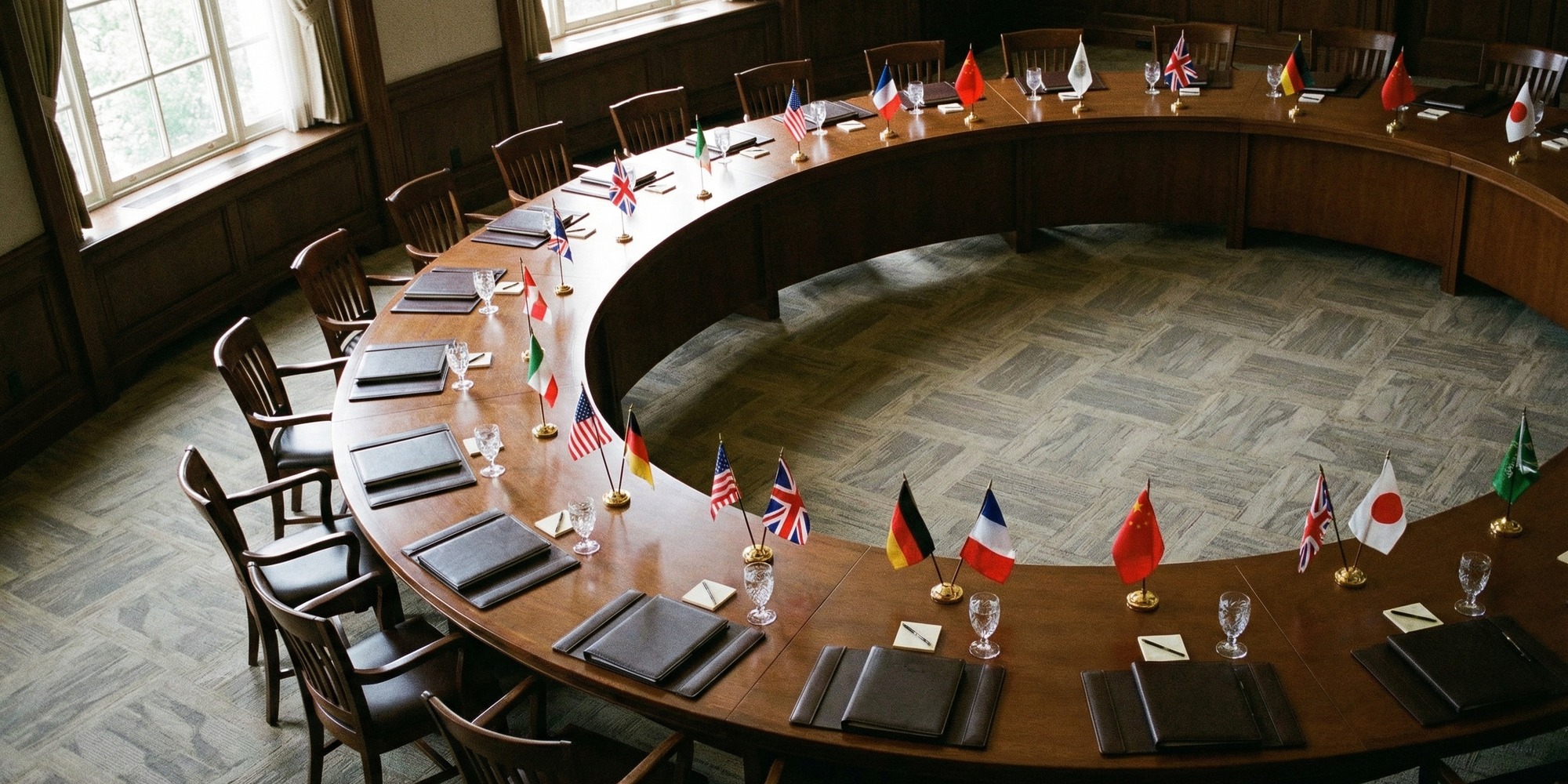
On day 27 of the US-Israeli air campaign against Iran, two peace frameworks were in public circulation — and both governments were denying their existence. Washington's 15-point proposal, leaked via Israel's Channel 12 and confirmed with caveats by the White House, demanded nuclear dismantlement, ballistic missile limits, and an end to Iran's regional proxy network. Tehran's counter-framework demanded war reparations, security guarantees against re-attack, and sole Iranian sovereignty over the Strait of Hormuz. The gap is not a negotiating distance — it is a structural divergence rooted in incompatible definitions of what a post-conflict order must look like.
As Brent crude held above $100 per barrel and Iranian drone strikes continued hitting Gulf infrastructure — debris killed two in Abu Dhabi on March 26 — the question was not whether a deal would be struck this week, but whether either framework could evolve to produce one.
Key Takeaways
- Washington's 15-point plan requires nuclear facility dismantlement, IAEA custody of enriched uranium, missile programme limits, proxy funding cuts, and Hormuz as a free maritime corridor.
- Tehran's five-condition counter-framework demands war reparations, a binding guarantee against future US-Israeli attack, and sole Iranian control over the Strait of Hormuz.
- Pakistan is serving as the primary diplomatic intermediary, with Witkoff and Kushner expected in Islamabad as early as March 27; Egypt maintains a parallel back-channel.
- Iran publicly denies that negotiations are occurring, even as it confirmed receipt of the plan to Pakistani and Egyptian officials — a structural pattern consistent with the pre-JCPOA back-channel period.
- HRANA reported 3,291 killed in Iran since February 28, including 1,455 civilians; Hormuz disruption has cut approximately 20% of global oil and gas supply.
The Fifteen Points Washington Is Asking For
The American framework, as reported by the Associated Press and confirmed in partial form by the White House, contains at least nine publicly disclosed demands. Iran must commit never to pursue nuclear weapons, dismantle its nuclear facilities, and transfer enriched uranium to International Atomic Energy Agency custody. Tehran must accept quantitative and range limits on its ballistic missile programme. It must end financial and material support for Hezbollah, Hamas remnants, and the Houthi forces in Yemen. And critically, it must commit to the Strait of Hormuz operating as a free maritime corridor under international navigation rules — surrendering the primary strategic lever that has given Tehran disproportionate influence over global energy markets throughout the conflict.
In exchange, Washington has offered comprehensive international sanctions relief. White House Press Secretary Karoline Leavitt framed the offer in unambiguous terms on March 26, stating that "President Trump does not bluff, and he is prepared to unleash hell. Iran should not miscalculate again." Trump had said days earlier that Iran was "desperate for a deal" and had offered "a very significant prize — related to oil and gas and the Strait of Hormuz." Tehran denied the characterisation. The economic stakes are significant: as US Market Updates has tracked, Hormuz disruption has kept Brent crude above $100 throughout the conflict, with every day of closure deepening inflationary pressure on global supply chains.
"President Trump does not bluff, and he is prepared to unleash hell. Iran should not miscalculate again."
— White House Press Secretary Karoline Leavitt, March 26, 2026
Tehran's Five Conditions
Iran's counter-framework, as articulated through state-run Press TV by an unnamed senior official on March 26, contains five demands that function less as negotiating positions than as political prerequisites for engagement. Tehran requires a complete halt to what it characterises as Israeli aggression and targeted assassinations. It demands concrete, verifiable mechanisms guaranteeing Iran will not be attacked again — in effect, a security guarantee of a kind the United States has never offered any regional adversary. It wants payment of war reparations and damages. It insists on sole Iranian sovereign control over the Strait of Hormuz. And it requires that Israel end its operations against Iranian allies across the region.
Foreign Minister Abbas Araghchi, speaking on Iranian state television on March 26, offered neither acceptance nor rejection, stating only that "some ideas had been proposed to the country's senior leaders — and if a position needs to be taken, it will certainly be determined." According to BBC News reporting, this response represents a structural feature of Iranian diplomatic behaviour: public denial alongside confirmed receipt, preserving domestic political cover while keeping the channel technically open. Iran's parliament speaker called the leaked plan "fake news." Its military spokesman said fighting "will continue until complete victory."
The trust deficit is acute. Tehran believes Washington launched its February 28 air campaign while Geneva negotiations were active — a second time, having interrupted a separate back-channel in June 2025. This pattern has produced a standing refusal to accept any framework that depends on American good faith without independent verification.
Pakistan, Egypt, and the Architecture of Denial
Operating beneath the mutual denials is a two-track intermediary structure. Pakistan has taken the primary role: Prime Minister Shehbaz Sharif publicly offered to "facilitate meaningful and conclusive talks," and Trump's designated negotiators Steve Witkoff and Jared Kushner — whose diplomatic approach to the Iran file US Foreign Policy has analysed in depth — were expected in Islamabad as early as March 27. Pakistan maintains workable relationships with both capitals, has geographic proximity to Iran, and served as a back-channel broker across multiple prior administrations.
Egypt is playing a parallel trust-building role. Egyptian Foreign Minister Badr Abdelatty confirmed an open line to Araghchi, drawing on Cairo's recent experience in Gaza ceasefire framework negotiations. Israel is explicitly excluded from the current channel — Prime Minister Netanyahu has reportedly resisted any ceasefire arrangement that leaves Iran's nuclear infrastructure or proxy network intact, mirroring his public position during the Gaza ceasefire process. Gulf Arab states — Saudi Arabia, the UAE, Bahrain — are watching proceedings with anxious neutrality: they prefer a return to pre-conflict stability but trust neither side enough to actively broker.
Why the Gap Is Structural, Not Tactical
For Washington and Jerusalem, the war's declared objectives — published by the White House on March 3 — include destruction of Iran's ballistic missile arsenal, denial of nuclear capability, degradation of Iran's navy, and severance of the proxy funding network. A ceasefire leaving any objective unmet would represent a strategic failure for an administration that framed the conflict as a decisive reckoning with decades of Iranian proxy warfare. The simultaneous deployment of 5,000 Marines and 82nd Airborne paratroopers signals military pressure is being maintained alongside diplomatic signalling, not replaced by it.
For Tehran, the calculus runs in the opposite direction. The Islamic Republic has survived 27 days of sustained US-Israeli airpower — a fact not lost on its domestic political base. Every day the regime endures, its narrative of resistance is reinforced. Hormuz leverage — the asset that makes Iran indispensable to global energy markets — cannot be surrendered without dismantling the strategic architecture underpinning Iranian foreign policy for four decades.
This structural incompatibility does not preclude a deal indefinitely. The JCPOA of 2015 required more than two years of back-channel work before its public framework emerged, with Iran publicly denying substantive contact for the first year. The current Pakistan-Egypt intermediary structure is, by that precedent, an early-stage process. What would need to change is not the existence of a framework, but the domestic political conditions in both capitals that make accepting the other side's terms survivable.
Conclusion
Both Washington and Tehran have signalled what they require from a post-conflict settlement — and neither is ready to accept the other's terms. The 15-point plan is the maximum Washington can claim as strategic success; the five conditions are the minimum Tehran can present without triggering a domestic legitimacy crisis. The two lists do not overlap. Both sides continue to fight, continue to deny they are talking, and continue to talk.
Fifteen points against five conditions, with neither capital willing to accept the other's paper, is the same Iran-war endgame stalemate tracked on the Armed Conflicts Map's Iran–US war page.