As U.S. and Israeli strikes reshaped the military map of the Middle East in early March 2026, a parallel campaign waged through balance sheets and banking blacklists accelerated alongside the conflict. Two coordinated sanctions actions — one by the State Department on February 6 and another by the U.S. Treasury's Office of Foreign Assets Control (OFAC) on February 25 — targeted the maritime infrastructure keeping Iran's petroleum revenues alive despite more than four decades of accumulated sanctions. Together, the two actions designated 26 tankers and more than 30 individuals, entities, and associated networks, the most intensive shadow fleet enforcement campaign mounted by Washington in a single month.
The timing is not incidental. Iran's primary source of hard currency remains the sale of crude oil and petrochemical products, and the U.S. government has consistently framed sanctions enforcement as a means of depriving Tehran of the revenue it channels into its nuclear programme, ballistic missile development, and proxy networks across the Middle East. With the conflict now openly kinetic, the economic dimension of that strategy has taken on renewed urgency.
Key Takeaways
- The State Department (February 6) and OFAC (February 25) together designated 26 shadow fleet tankers and 30+ related entities in the single most intensive month of Iran sanctions enforcement on record.
- Iran's shadow fleet relies on aging tankers with opaque ownership structures, sailing without top-tier insurance, to deliver crude primarily to buyers in China and other East Asian markets.
- All designations were made under Executive Order 13846, which reimposed sweeping U.S. sanctions on Iran following the 2018 JCPOA withdrawal and remains the primary legal instrument for petroleum-related enforcement.
- Senior Iranian officials have stated that Tehran and Washington remain "sharply divided" on which sanctions must be lifted before any renewed nuclear negotiations can progress.
Anatomy of a Shadow Fleet
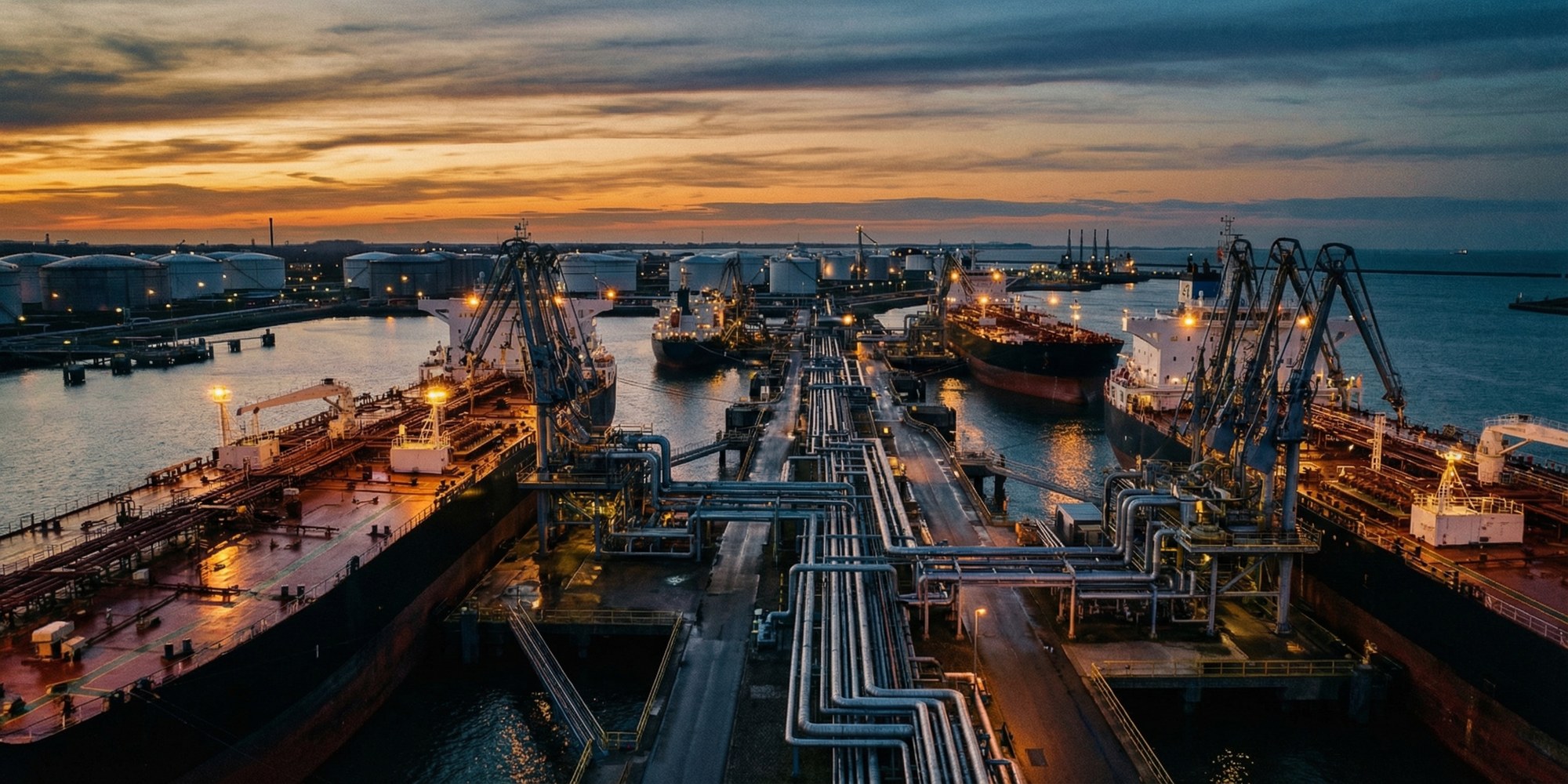
The term "shadow fleet" refers to a loosely connected network of aging oil tankers that circumvent sanctions by concealing their cargo origins, changing flags, disabling tracking transponders, and conducting ship-to-ship transfers in international waters beyond easy regulatory reach. Unlike the vessels serving Western oil majors, shadow fleet tankers typically operate without top-tier maritime insurance, making them ineligible for most major ports but not for the smaller, less scrutinized terminals where Iranian crude is routinely loaded and offloaded.
According to the State Department's February 6 action, vessels managed by companies such as All Win Shipping Management Limited and Manarat Alkhaleej Marine Services — both identified as having managed tankers that transported Iranian petroleum — are emblematic of the broader network: nominally registered in third countries such as Barbados and Panama, commercially managed through intermediaries in the UAE, and ultimately serving end buyers in East Asia. One vessel flagged in that action, the AL SAFA, had completed at least 30 shipments originating from Iran in 2025 alone.
"Iran exploits financial systems to sell illicit oil, launder the proceeds, procure components for its nuclear and conventional weapons programs, and fund its proxies and partners."
— U.S. Department of the Treasury, Office of Foreign Assets Control, February 25, 2026
The February Enforcement Surge
The State Department's February 6 action was the larger of the two rounds in terms of maritime designations. The department identified 14 shadow fleet vessels as blocked property under Executive Order 13846 — the same order President Trump signed in 2018 when the United States withdrew from the Joint Comprehensive Plan of Action (JCPOA) and reimposed comprehensive sanctions on Iran. Alongside those vessel designations, 15 entities and two individuals involved in trading Iranian-origin petroleum were sanctioned. The State Department explicitly framed the action as targeting "the regime's primary source of income."
Three weeks later, on February 25, OFAC followed with a complementary package targeting 12 additional shadow fleet vessels and the networks behind Iran's ballistic missile and weapons procurement pipelines. That action also identified entities involved in securing precursor materials and machinery for weapons production, drawing a direct line from petroleum revenues to military capability. Collectively, the February designations represented a significant escalation in the pace and scope of secondary sanctions enforcement — an enforcement pressure that, as analysts tracking global energy markets have noted, is already filtering into crude pricing as traders recalibrate Iranian supply assumptions.
China's Role and the Enforcement Ceiling
The central challenge confronting U.S. sanctions architects remains unchanged: Iran's largest petroleum customer, China, is not subject to American jurisdiction and has shown no inclination to honour U.S. secondary sanctions as a matter of domestic policy. Chinese state-owned refiners and independent "teapot" refineries in Shandong province have continued to absorb Iranian crude — at substantial discounts to benchmark prices — throughout 2025 and into 2026. OFAC's February package targeted multiple networks described as facilitating petroleum flows to East Asia, but sanctioning the intermediaries does not compel Chinese buyers to halt purchases; it raises transaction costs and complicates logistics without imposing a hard ceiling on volumes.
India, which had also been a significant buyer of Iranian crude before the reimposition of sanctions in 2018, has maintained a more cautious posture, particularly as New Delhi has sought to preserve access to the U.S. financial system. The divergence between Indian and Chinese behaviour illustrates a broader asymmetry in U.S. sanctions leverage: effective against countries with deep integration into dollar-denominated trade and finance, considerably less so against economies with alternative clearing arrangements or sufficient political will to absorb secondary designations.
For U.S. markets, the sanctions campaign's indirect effects have proven more significant than direct enforcement. Suppressed Iranian export capacity — even partially — contributes to tighter global supply, a dynamic that has amplified the price volatility accompanying the current conflict. The Dow's sharp sell-off as oil surged past $82 per barrel following the Strait of Hormuz military exchange illustrated how intertwined financial markets have become with the outcome of the sanctions-and-conflict dynamic playing out across the Persian Gulf.
Sanctions, Negotiations, and Strategic Leverage
A central question in the Iran policy debate concerns whether escalating economic pressure is compatible with a negotiated nuclear settlement. The Trump administration's position is that maximum pressure — combining military posture with comprehensive sanctions enforcement — is designed to bring Tehran to the table on favourable terms. European diplomats and arms control analysts have countered that sanctions escalation during active conflict forecloses negotiating space by hardening domestic political positions on both sides.
Iranian officials have shown no readiness to negotiate under fire. A senior Iranian official told Reuters in late February that Tehran and Washington "remain sharply divided over which sanctions should be lifted and when." The JCPOA's collapse in 2018 demonstrated Iran's willingness to endure significant economic dislocation rather than accept asymmetric terms — a posture the current conflict appears only to have reinforced.
A Pressure Campaign Without a Clear Endpoint
The February 2026 shadow fleet designations raise costs, complicate logistics, and signal that Washington will sanction facilitators regardless of national flag. But they also reflect the structural limits of economic statecraft against a regime that has adapted its petroleum export infrastructure to operate in a sanctioned environment over decades. As diplomatic channels remain frozen, the campaign's ultimate measure of success will depend on whether economic pressure can translate into political conditions that neither side has yet shown any willingness to accept.
The February designations raise the cost of Tehran's wartime oil revenue without resolving the war that made that revenue urgent — the same economic front of the 2026 campaign recorded on the Armed Conflicts Map's Iran–US war page.