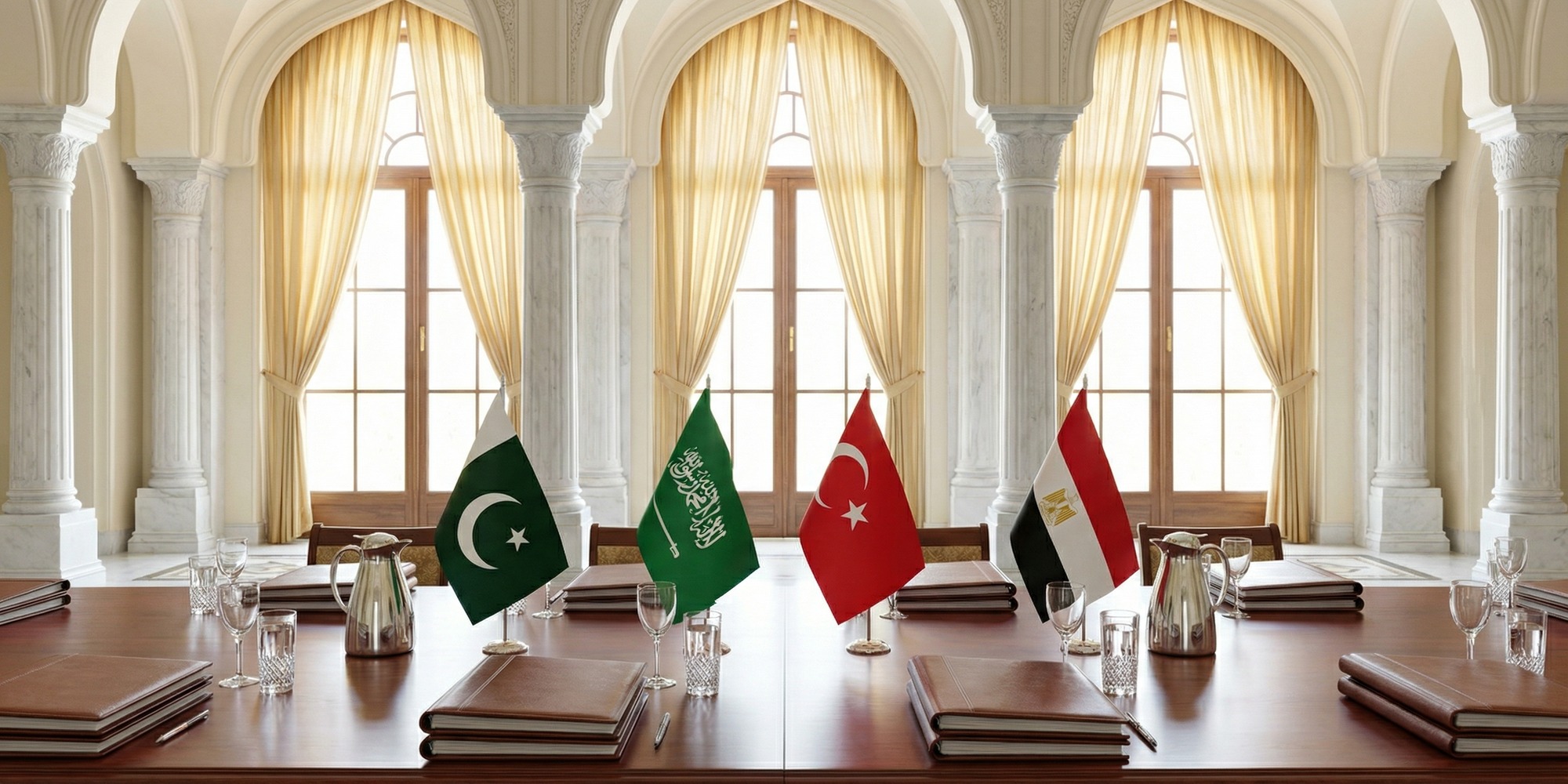
On Sunday morning, Islamabad received an unusual diplomatic convergence. Foreign ministers and senior envoys from Saudi Arabia, Turkey, and Egypt arrived in the Pakistani capital for a two-day summit aimed explicitly at breaking the ceasefire impasse between the United States and Iran. The gathering marks a formal acknowledgment of what has quietly been true for weeks: that Pakistan — not Oman, not Qatar, not Switzerland — has become the indispensable conduit between Washington and Tehran in a war now entering its second month.
Pakistani Prime Minister Shehbaz Sharif confirmed late Saturday that he had held "extensive discussions" with Iranian President Masoud Pezeshkian on the regional hostilities — discussions conducted through a channel that both governments acknowledge exists but neither side has officially named. The scale of Sunday's summit, drawing top diplomats from the Gulf and the eastern Mediterranean to the same table in Islamabad, signals that this back channel has become something more: the architecture of any viable off-ramp before the April 6 deadline imposed by President Trump for Iran to reopen the Strait of Hormuz.
Key Takeaways
- Pakistan has confirmed it is relaying US ceasefire proposals to Tehran and Iranian responses to Washington, functioning as the primary back channel between the two warring parties.
- Saudi Arabia, Turkey, and Egypt sent top diplomats to Islamabad on March 29 for a two-day summit — the most structured multilateral diplomatic initiative since ceasefire talks stalled.
- Iran's FM Araghchi has publicly described Tehran as "skeptical" of recent diplomatic efforts, citing what Iran calls US "unreasonable demands" and "contradictory actions."
- Pakistan's domestic stakes are acute: 5 million Pakistani workers in the Arab world, fuel prices up ~20%, and significant internal unrest tied to the ongoing conflict.
Why Pakistan? The Structural Logic
The conventional intermediaries are no longer available. Oman, which historically hosted the discreet US-Iran nuclear talks that produced the 2015 JCPOA, has come under Iranian pressure and is managing its own precarious neutrality. Qatar faces similar constraints. Pakistan, by contrast, occupies a uniquely triangulated diplomatic position: it has no diplomatic relations with Israel, yet it maintains working relationships with the United States, Iran, the Gulf Cooperation Council, Turkey, and Egypt — the precise constellation of actors any durable ceasefire will require.
The personal dimension matters too. Pakistani Army Chief Field Marshal Asim Munir has been described by Donald Trump as his "favorite Field Marshal" — a characterization the White House has done nothing to correct. Islamabad signed a defense cooperation agreement with Saudi Arabia in 2025 and maintains functional military-to-military ties with the US Central Command. When US envoy Steve Witkoff needed the 15-point ceasefire proposal transmitted to Tehran weeks ago, the back-channel ran through Islamabad. Pakistani officials have since confirmed that US messages are passed to Tehran and Iranian responses relayed back to Washington, though neither government officially acknowledges the arrangement.
Pakistan's credibility as an interlocutor rests on a longer track record. General Yahya Khan facilitated the back-channel contacts that enabled Henry Kissinger's secret 1971 trip to Beijing and Nixon's historic 1972 China opening. Islamabad helped broker the 1988 Geneva Accords governing the Soviet withdrawal from Afghanistan, and in 2020 Pakistan facilitated Taliban-US contacts that produced the Doha Agreement. Each episode involved Pakistan positioning itself between adversaries without direct communication. The current configuration is structurally familiar.
The Back Channel and Its Limits
Pakistani Foreign Minister Ishaq Dar has been the most direct Pakistani official to speak publicly on the channel's content. Meeting with Iranian Foreign Minister Abbas Araghchi, Dar urged his counterpart to support what Islamabad wants most: a clean halt to hostilities.
"An end to all attacks and hostilities."
— Pakistani Foreign Minister Ishaq Dar, urging Iranian FM Araghchi, March 28, 2026 (AP News)
Tehran's response has been cautious. Araghchi told his Turkish counterpart that Iran was "skeptical" about recent diplomatic efforts and accused Washington of "unreasonable demands" and "contradictory actions." The US 15-point ceasefire proposal demands nuclear dismantlement, cuts to proxy funding, and IRGC restructuring. Tehran's five-condition counter-framework insists on war reparations and Hormuz sovereignty. The gap is structural, not merely rhetorical. But skepticism is not rejection, and Islamabad is betting that a multilateral framing — one that gives Iran a face-saving off-ramp and the US political cover — is more viable than the current bilateral impasse. As analysts at US Foreign Policy have documented, Secretary Rubio's G7 proposals reflect a similar logic: multilateral pressure applied through intermediaries, not direct coercion.
What Pakistan Stands to Lose
Islamabad is not a disinterested party. Five million Pakistani citizens work in the Arab world; their remittances are roughly equivalent to Pakistan's total export earnings. Since the Strait of Hormuz tightened in late February, Pakistan has raised domestic fuel prices by approximately 20 percent. The war has also catalyzed internal unrest: protests erupted after US strikes killed Supreme Leader Khamenei, 22 people died in clashes, and the American consulate in Karachi was temporarily breached. Islamabad is simultaneously managing its own eastern border tensions with Afghan Taliban-linked forces.
That economic exposure gives Pakistan's diplomatic engagement an urgency that purely strategic motivations would not provide. The ceasefire is not only a foreign policy objective for Islamabad — it is a domestic economic necessity. The financial pressure is reflected in markets globally: US equities have recorded their worst stretch since the conflict began, with Treasury yields spiking as ceasefire hopes fade — a dynamic US Market Updates has tracked closely as the April 6 deadline approaches.
A Widening War, a Narrowing Window
The summit convenes against a backdrop of escalation, not de-escalation. On Saturday, Houthi forces fired two missiles toward southern Israel — their first direct strikes on Israeli territory in support of Iran — formally re-entering a conflict that had previously been limited to Gulf and Iranian theater. Our earlier coverage examined how Iran's broader proxy network has extended the conflict's perimeter. Iran's Islamic Revolutionary Guard Corps separately claimed attacks on aluminium facilities in the UAE and Bahrain — Aluminium Bahrain and Emirates Global Aluminium — framing the strikes as retaliation for Iranian infrastructure damage. In Tehran's parliament, hardline members are renewing calls for withdrawal from the Nuclear Non-Proliferation Treaty.
Meanwhile, the United States says it is within "a few days" of completing strikes against essential Iranian weapons production sites. US warships carrying approximately 2,500 Marines trained in amphibious operations have arrived in the region, and more than 1,000 paratroopers from the 82nd Airborne Division have been ordered forward. Secretary of State Rubio has maintained that Washington "can achieve all of our objectives without ground troops," but the military posture tells a different story about contingency planning.
Analysis: The Precedent and Its Limits
Four-nation summitry in Islamabad cannot by itself unlock a ceasefire that requires agreement from Washington and Tehran. What Sunday's gathering can test is whether multilateral framing changes the calculus for either capital. Araghchi's public skepticism and the hardliner pressure building in Tehran's parliament are genuine structural constraints. On the US side, the April 6 deadline gives the administration limited political room to be seen as softening demands without visible Iranian movement.
Pakistan's historical track record in exactly these configurations — adversaries who need a neutral venue, a trusted carrier, and plausible deniability — confers a rare credibility. But 1972, 1988, and 2020 all involved parties who, at some level, wanted a negotiated outcome. Whether that precondition is met today, as strikes continue and Houthi missiles arc toward Israeli cities, is the question that Islamabad cannot resolve alone — only host.
Pakistan's March role as a ceasefire broker between Washington and Tehran is the same Islamabad channel later recorded on the Armed Conflicts Map's Iran–US war tracker.