The next UN Secretary-General is appointed by the General Assembly on the Security Council’s recommendation. Article 97 of the Charter is the rule. The Council narrows the field first, through informal secret straw polls whose tallies the United Nations does not publish. As of 10 October 2026, the Council president had described a fifth round, held on 7 October, and the UN selection page recorded no formal recommendation. António Guterres’s second term ends on 31 December 2026.
A lead on an undifferentiated ballot can still hide a permanent member’s “discourage” mark. That is why colour-coding exists: the formal test, in Article 27, is nine affirmative votes, including the concurring votes of the permanent members.
Key Takeaways
- The Secretary-General is appointed by the General Assembly on the Security Council’s recommendation, under Article 97. Resolution 79/327 sets the 2026 steps around that rule.
- A straw poll is an informal secret ballot, one paper per candidate, marked encourage, discourage, or no opinion. The UN does not publish the tally.
- Colour-coded ballots separate permanent-member papers from elected-member papers, so a discourage from one of the five can be seen as a likely veto. The first colour-coded poll of the 2016 race was on 5 October 2016.
- On 7 October 2026 the Council president said a fifth round had taken place. PassBlue reported that diplomats expected another poll on 16 October, possibly colour-coded. She did not announce that date.
How is the UN Secretary-General chosen?
The General Assembly appoints the Secretary-General on the Security Council’s recommendation. The Charter provides no other route.
“The Secretary-General shall be appointed by the General Assembly upon the recommendation of the Security Council.”
— United Nations Charter, Article 97
General Assembly resolution 79/327, adopted on 5 September 2025, sets those steps “without prejudice to the prerogatives of the Security Council, and in strict compliance with Article 97.” A joint letter opens the process in the last quarter before the incumbent’s term ends. States nominate. Each candidate files a vision statement and discloses campaign funding. The Assembly president holds webcast dialogues. The two presidents publish the list. The appointment is still the Assembly’s act on the Council’s recommendation.
The joint letter that opened this race was published on 25 November 2025 as A/80/544-S/2025/765. The UN selection page is the public list that letter required.
Straw polls are Council practice. Resolution 79/327 does not name them. On 28 July 2026 the Assembly president, Annalena Baerbock, wrote that any candidate should be heard in an interactive dialogue “before being considered by the Security Council in its straw polls,” and she referred to consideration starting on 30 July (PGA letter, 28 July 2026). Her letter of 4 September, A/80/823, passed the Assembly side to Khalilur Rahman when the eightieth session ended on 8 September.
What is a UN Security Council straw poll?
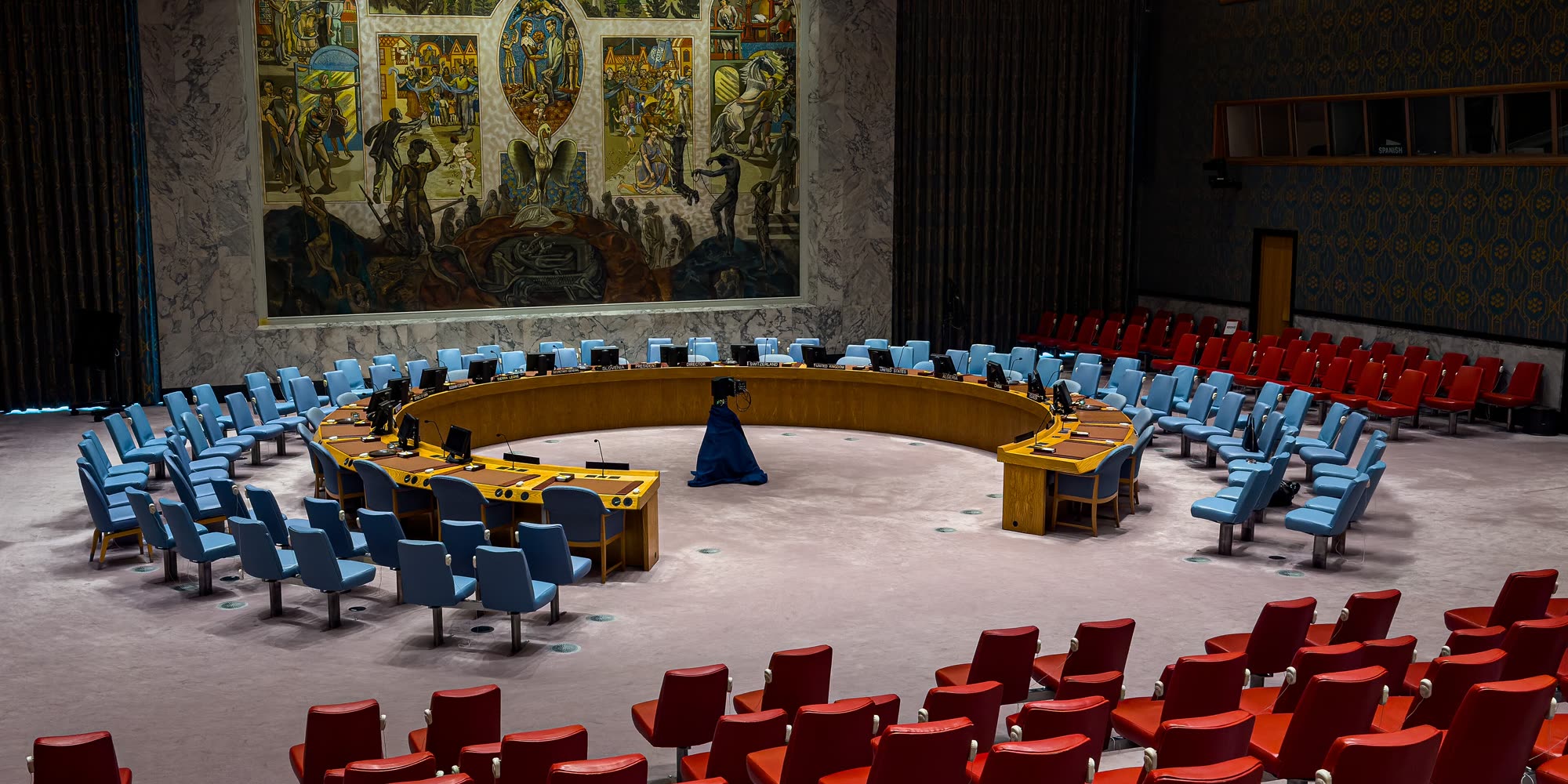
A straw poll is an informal secret ballot. Members use it to test which names could survive a formal recommendation. It is not that recommendation, and the United Nations does not publish the count.
Security Council Report, previewing the 7 October round, described one ballot per candidate, with three options — “encouraged,” “discouraged,” and “no opinion expressed” — and no distinction, in that round, between permanent and elected members. The president would say a poll had happened and would not give results. The same note dated the earlier rounds to 30 July, 21 August, 18 September, and 29 September 2026 (Security Council Report, 6 October 2026). The 30 July start is in Baerbock’s letter. The other three dates are that calendar, not a UN communiqué.
On 18 September, AFP reported that Jérôme Bonnafont of France, then Council president, said only that “the third round of straw polls has taken place” (France 24 / AFP, 18 September 2026). On 7 October, Aglaia Balta of Greece spoke at a stakeout that UN Web TV recorded. Anadolu Agency quoted her:
“The fifth round of straw polls has taken place. Each candidate will be informed of their results through their respective permanent representatives of nominating member states. The president of the General Assembly will also be informed that the straw poll has been conducted.”
— Aglaia Balta, President of the Security Council, as reported by Anadolu Agency, 7 October 2026
Anadolu reported that Balta gave no date for another poll. This page does not repeat leaked counts. PassBlue, citing several Council diplomats, reported that the next straw poll was scheduled for 16 October and might be colour-coded, so permanent members’ papers could be told from the other ten without naming the capital (PassBlue, 7 October 2026). That is what diplomats told PassBlue. It is not a Council programme of work.
What do colour-coded ballots change?
Colour-coded ballots make a permanent member’s “discourage” visible as a class of vote, which is the practical signal of a veto. They do not name which of the five cast it.
The precedent is a UN record. On 5 October 2016 the President of the General Assembly said he had been told that “the sixth informal and first colour-coded straw poll” had taken place, that António Guterres had “emerged as the unanimous choice,” and that a formal vote was expected the next day (PGA statement, 5 October 2016). Security Council Report, previewing that round, wrote that permanent members would receive red ballot papers, with the same three columns (Security Council Report, October 2016).
Article 27 says decisions that are not procedural “shall be made by an affirmative vote of nine members including the concurring votes of the permanent members.” A recommendation to appoint the Secretary-General is that kind of decision. Nine encourage marks on an undifferentiated ballot can sit beside a permanent member’s discourage mark. Colour-coding is how the Council sees whether that has happened before it spends a resolution on a name that cannot pass. A marked discourage paper is a warning, not the veto. The veto is the formal vote. How Washington has used it on the Iran file is covered at US Foreign Policy. Rewriting the instrument itself is a different negotiation: the African model now before the Assembly is tracked separately.
Who are the candidates for UN Secretary-General in 2026?
The UN selection page, consulted on 10 October 2026, lists nominations alphabetically by name, nominating state, and date. Seven had not been withdrawn.
- Ivonne A-Baki, nominated by Tonga on 17 August 2026 (A/80/814-S/2026/684).
- María Fernanda Espinosa Garcés, nominated by Antigua and Barbuda on 11 May 2026 (A/80/736-S/2026/408).
- Rafael Mariano Grossi, nominated by Argentina on 26 November 2025 (A/80/549-S/2025/775).
- Rebeca Grynspan Mayufis, nominated by Costa Rica on 3 March 2026 (A/80/666-S/2026/124).
- Olara Otunnu, nominated by Uganda on 24 July 2026 (A/80/802-S/2026/612).
- Carolyn Rodrigues Birkett, nominated by Guyana on 15 June 2026 (A/80/764-S/2026/498).
- Macky Sall, nominated by Burundi on 2 March 2026 (A/80/662-S/2026/123).
Two nominations on the same page were withdrawn, which resolution 79/327 allows a nominating state to do at any time. Virginia Gamba was nominated by the Maldives on 11 March 2026 and withdrawn on 25 March 2026 (A/80/695-S/2026/236). Michelle Bachelet Jeria was nominated by Chile, Brazil, and Mexico on 2 February 2026 (A/80/616-S/2026/56); Chile withdrew on 25 March 2026 (A/80/694-S/2026/226), and Brazil and Mexico withdrew on 21 September 2026 (A/81/384-S/2026/753). The page is the list. How the field was opened is in the April account.
What happens after the straw polls?
The Council adopts a resolution recommending one name, and the General Assembly appoints on that recommendation. Nothing on the 2026 selection page, as of 10 October, records that resolution.
Security Council resolution 2580 (2021) recommended that Guterres be appointed for a second term from 1 January 2022 to 31 December 2026, and the General Assembly appointed him by acclamation on 18 June 2021 for that span (UN News, 18 June 2021). A UN Web TV note on this race says the next Secretary-General will take office in January 2027 (UN Web TV, 24 April 2026). Resolution 79/327 says the swearing-in should come in the last quarter of the year before the term begins.
“Noting with regret that no woman has ever held the position of Secretary-General, encourages Member States to strongly consider nominating women as candidates.”
— General Assembly resolution 79/327, paragraph 42(c), 5 September 2025
It also reaffirms “equal and fair distribution in terms of the gender and geographical balance” for executive heads, including the Secretary-General, “while meeting the highest possible standards.” That is an encouragement to the states that nominate. It does not move the recommendation.
Whoever is appointed inherits a war agenda that is already crowded; the running count is at Armed Conflicts. BRICS declarations have repeated a call for a greater voice for emerging economies in the UN system — the record BRICS Policy follows — and that language does not amend Article 27. The appointment still waits on a recommendation the Council will actually cast.